
Posts

2026 Best Electric Forklift Battery Types for Buyers

Choosing the best Electric Forklift Battery in 2026 will depend on work patterns, not marketing alone. A cold-storage warehouse, a busy distribution center, and a small workshop face different battery pressures. Shift length matters. Charging space matters. So does operator behavior.

The U.S. Environmental Protection Agency reports that lead-acid batteries achieve recycling rates above 99% in the United States. This supports their strong environmental and supply-chain credentials. However, lead-acid batteries may require watering, ventilation, and scheduled charging breaks. OSHA’s powered industrial truck standard, 29 CFR 1910.178, also addresses battery charging areas, ventilation, and safe handling practices. These details become very real beside a charging station, where heat, spilled electrolyte, and limited floor space can affect daily productivity.

Lithium-ion batteries offer opportunity charging, steady voltage, and reduced routine maintenance. The International Energy Agency’s Global EV Outlook 2024 reported more than 750 GWh of global electric-vehicle battery demand in 2023. That scale is accelerating battery manufacturing, but forklift buyers should not assume every lithium pack has equal quality, service support, or thermal protection. Battery life also depends on temperature, charging habits, and fleet software.

There is no universal winner.

This guide compares lead-acid, lithium-ion, and emerging battery options through operating cost, usable energy, charging time, safety, lifespan, and total ownership value. Some conclusions may challenge simple payback calculations. A cheaper battery can become expensive when forklifts wait, batteries are swapped, or maintenance records remain incomplete. Reliable purchasing requires measured duty cycles, verified specifications, and practical feedback from operators.
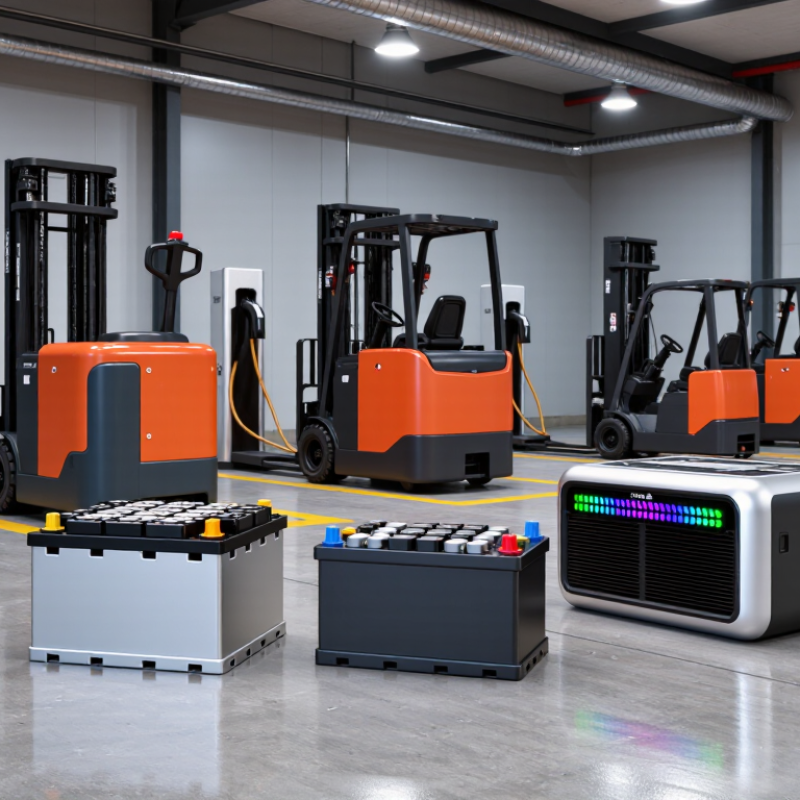
2026 Best Electric Forklift Battery Types for Buyers

Electric Forklift Battery Basics for 2026 Buyers

For 2026 buyers, electric forklift battery selection starts with duty cycle, not advertised capacity. A battery must match daily lift hours, load weight, charging access, and operating temperature. Lead-acid batteries remain practical for fleets with scheduled shifts and dedicated charging rooms. They usually require watering, ventilation, and careful charging discipline. That work is often underestimated. Lithium-ion batteries support opportunity charging and consistent voltage during demanding shifts. They typically reduce routine maintenance, but their purchase price and charging infrastructure need closer review.

Absorbed glass mat batteries can suit lighter applications where spill resistance and low maintenance matter. However, chemistry alone does not determine performance. Check usable amp-hour capacity, charger compatibility, battery compartment dimensions, and connector specifications. A forklift that fits the aisle may still fail the battery test. Measure actual demand. Compare energy use across a normal week, including breaks, cold starts, and partial charges. Ask operators when power drops, because performance complaints often reveal poor sizing. This is practical evidence, not just a catalog figure.

Reliable purchasing also requires documented safety procedures, trained personnel, and supplier test data. Request cycle-life conditions, warranty limits, charging temperatures, and expected capacity retention. Numbers without test conditions can mislead. Inspect used batteries for heat marks, swelling, damaged cables, and uneven case surfaces. Do not ignore floor conditions or long travel distances; both increase energy demand. I have seen attractive calculations fail after winter shifts changed charging patterns. Leave room for that uncertainty. A modest pilot on one truck can expose problems before fleet-wide spending.

2026 Best Electric Forklift Battery Types for Buyers - Electric Forklift Battery Basics for 2026 Buyers

Battery Type Typical Forklift Voltage Recommended Usable Depth of Discharge Typical Cycle Life Typical Recharge Time Energy Efficiency Maintenance Requirement Opportunity Charging Best-Fit Applications
Flooded Lead-Acid 24–80 V Up to about 80% 1,000–1,500 cycles 8–10 hours, plus cooling time Approximately 70–85% High: watering, cleaning, ventilation, and equalization charging Generally not recommended Single-shift operations with a dedicated battery-changing area and lower initial budget
Absorbent Glass Mat Lead-Acid 12–48 V; larger industrial packs are available About 50–70% 500–1,000 cycles 8–12 hours Approximately 70–85% Low to moderate; no routine watering, but charging and temperature control remain important Limited; frequent partial charging can shorten service life Light-duty equipment, compact trucks, and applications needing a sealed battery design
Gel Lead-Acid 12–48 V; larger industrial packs are available About 50–70% 600–1,200 cycles 8–12 hours Approximately 70–85% Low; sealed construction reduces watering requirements Limited; charging must follow the battery maker’s voltage profile Low-emission indoor areas, clean facilities, and moderate-duty warehouse work
Lithium Iron Phosphate (LFP) 24–96 V About 80–90% 3,000–6,000 cycles 1–3 hours with a suitable high-frequency charger Approximately 90–98% Low; battery management, connector inspection, and thermal monitoring are still required Yes; well suited to frequent short charging periods Multi-shift warehouses, cold-chain logistics, high-utilization fleets, and operations without battery swapping
Nickel-Metal Hydride 24–80 V, depending on pack design About 60–80% 1,500–3,000 cycles 2–6 hours Approximately 70–85% Low; requires compatible charging and temperature monitoring Possible, but charging strategy should be matched to the pack design Specialized fleets requiring a robust sealed battery with stable performance
Sodium-Ion Commonly designed for 24–80 V systems About 80–90% Approximately 2,000–4,000 cycles in current commercial designs 1–3 hours with a compatible charger Typically lower than LFP; performance varies by cell design Low; electronic monitoring and correct charging are required Generally suitable where the battery management system permits it Emerging applications prioritizing improved low-temperature behavior and reduced dependence on lithium materials
Buyer Notes: Actual performance depends on battery capacity, truck class, load weight, duty cycle, ambient temperature, charger settings, and maintenance practices. Cycle-life figures are typical planning ranges rather than guaranteed values. Confirm voltage, dimensions, connector type, charger compatibility, ventilation requirements, and required counterweight before purchase.

How Lead-Acid, Lithium-Ion, and Emerging Batteries Differ

2026 Best Electric Forklift Battery Types for Buyers

Lead-acid batteries remain practical for warehouses with predictable shifts and charging space. Their purchase price is usually lower, but daily work is more demanding. Operators must check water levels, clean terminals, and manage charging fumes. A battery may need several hours before reuse. In a busy dock, that delay can require spare batteries and lifting equipment. Ventilation also matters. Small maintenance mistakes can shorten service life quickly.

Lithium-ion batteries support opportunity charging during breaks or shift changes. They need no routine watering, and they usually provide steadier voltage during operation. This can help forklifts maintain lifting performance near the end of a shift. However, the higher initial cost deserves careful calculation. Charging hardware, temperature controls, and battery management systems affect the real investment. Fast charging is useful, but it is not free. A spreadsheet can mislead if labor and downtime are ignored.

Emerging options, including sodium-ion and solid-state designs, deserve attention but cautious testing. Sodium-ion batteries may reduce dependence on certain critical materials and perform reliably in colder areas. Their energy density and industrial track record still need closer evaluation. Solid-state batteries could improve safety and storage capacity, yet many applications remain developmental. I would request verified cycle data, service procedures, and cold-weather results before approving them. New does not always mean better. A controlled warehouse trial may reveal uncomfortable gaps.

Key Battery Specifications: Voltage, Capacity, Runtime, and Charging

Choosing the best electric forklift battery in 2026 starts with four practical specifications: voltage, capacity, runtime, and charging needs. Common systems range from 24 to 80 volts, but the correct voltage must match the forklift’s electrical design. A higher voltage does not automatically provide better performance. It may also require different chargers, connectors, and service procedures.

Capacity is usually measured in ampere-hours (Ah). Energy can be estimated with this formula: voltage × Ah ÷ 1,000 equals kilowatt-hours. For example, a 48-volt, 600-Ah battery stores about 28.8 kWh under rated conditions. Actual runtime will be shorter or longer. Load weight, travel distance, lift height, floor condition, temperature, and driving habits all change energy use. Plan for the real shift.

Runtime testing matters more than brochure figures. Record operating hours, battery temperature, charging time, and remaining capacity during a normal workday. A battery lasting eight hours in light pallet movement may fail early in a cold warehouse. Charging speed also affects productivity. Conventional charging may require a replacement battery, while opportunity charging can support shorter breaks. However, frequent charging is not suitable for every battery design.

A clean calculation can still mislead.

Leave a practical reserve instead of using the full rated capacity. I have seen schedules fail because charging time was treated as downtime without measurement. Check the forklift manual, charger output, connector type, and workplace procedures before purchasing.

2026 Best Electric Forklift Battery Types for Buyers

The chart compares typical operating runtime and recharge time for common industrial forklift battery types. Actual performance varies with forklift load, battery age, ambient temperature, duty cycle, charger efficiency, and maintenance practices.

Battery Type Typical Voltage Typical Capacity Typical Runtime Typical Charging Time Key Buyer Consideration
Flooded Lead-Acid 24–80 V 300–1,000 Ah 6–8 hours 8–10 hours Lower upfront cost; requires watering, ventilation, and regular maintenance.
Lithium Iron Phosphate 24–80 V 300–1,000 Ah 6–8 hours 2–3 hours Fast charging and opportunity charging; higher initial purchase cost.
AGM Lead-Acid 24–80 V 200–800 Ah 5–7 hours 8–12 hours Sealed and low-maintenance design; generally lower energy density than lithium-ion.

For single-shift operations with scheduled charging, flooded lead-acid batteries remain a practical choice. Lithium iron phosphate batteries are typically better suited to multi-shift operations, limited battery-swap space, and facilities that can use short opportunity-charging periods.

Matching Battery Types to Warehouse Tasks and Operating Conditions

2026 Best Electric Forklift Battery Types for Buyers

Matching Battery Types to Warehouse Tasks and Operating Conditions

Choosing the best electric forklift battery starts with the work, not the catalog. A single-shift warehouse with planned breaks can still use lead-acid batteries effectively. They cost less initially, but charging, watering, and cooling require disciplined routines. Maintenance gaps create avoidable downtime. For intensive, multi-shift operations, lithium-ion batteries often match the schedule better. They support opportunity charging and usually need less daily maintenance. That advantage matters when forklifts return for short, irregular breaks.

Cold storage changes the decision. Low temperatures can reduce available battery capacity and slow charging, so test equipment inside the actual work zone. Lithium-ion systems may need thermal controls, while lead-acid units may require longer recovery periods. Dust, wash-down areas, and uneven floors also affect enclosures, connectors, and inspection frequency. Battery weight matters too. Some forklifts depend on battery mass for stability, so a lighter replacement is not automatically suitable. Check the truck’s approved battery range and the charging room’s electrical capacity before purchasing.

A practical evaluation should record energy use, break patterns, ambient temperature, and charger access for several operating days. Compare total operating cost, not only purchase price. Include labor, downtime, ventilation, replacement timing, and training. I would also question optimistic runtime claims. Real loads, worn tires, traffic congestion, and winter doors can change results. The best choice fits the warehouse’s rhythm, protects stability, and remains serviceable under pressure.

2026 Buyer Checklist for Cost, Safety, Maintenance, and Sustainability

2026 Best Electric Forklift Battery Types for Buyers

2026 Buyer Checklist for Cost, Safety, Maintenance, and Sustainability

Battery choice affects purchase price, charging time, floor productivity, and replacement planning. Price alone misleads. Compare the complete operating cost, including chargers, electricity, labor, downtime, and expected battery life.

Lead-acid batteries often cost less initially, but they need watering, ventilation, and scheduled charging. Lithium-ion batteries usually offer faster opportunity charging and less routine labor. Absorbent glass mat batteries may suit smaller operations with moderate daily demand.

Safety deserves direct inspection. Check charging zones, cable condition, ventilation, emergency access, and operator training. Lithium-ion systems need protection against impact, overheating, and poorly managed charging. Lead-acid systems require suitable eye protection and controls for electrolyte exposure. Ask for documented test results, protection features, and service procedures. Follow local safety requirements and the battery manufacturer’s instructions.

Maintenance records reveal more than sales claims. Review connector wear, charging history, battery temperature, and performance under load. A simple weekly log can expose gradual capacity loss before it stops a shift.

Sustainability also depends on repairability, recycling arrangements, energy efficiency, and battery lifespan. Ask who collects the battery at retirement.

Some buyers overlook charger compatibility and building electrical limits. I would also question optimistic cycle-life figures, because heavy heat, deep discharge, and poor charging habits can reduce them sharply.

No checklist is perfect. Test one unit during a real shift before committing to a full fleet.