Posts

What Is Barite Drywall Radiation Shielding?

Barite Drywall Radiation Shielding refers to specialized wall panels made with gypsum and barite, a dense mineral rich in barium sulfate. These panels help reduce scattered and primary X-ray radiation in selected medical, dental, veterinary, and industrial imaging rooms. Their dense core performs differently from standard drywall. It can make a wall feel noticeably heavier during installation.

The protection does not come from the panel alone. Room layout, equipment voltage, workload, occupancy, joints, doors, windows, and penetrations all affect shielding performance. A qualified medical physicist or radiation shielding consultant should calculate the required thickness. Local building and radiation-safety requirements also need review. One detail matters: gaps around electrical outlets can weaken an otherwise well-designed barrier.

Manufacturers may provide laboratory data, installation instructions, and tested attenuation values. However, product claims should be compared with the actual imaging equipment and room conditions. Barite drywall is not a universal substitute for concrete, lead, or other shielding systems. It is also not designed to solve every radiation hazard. The term can sound broader than its real application.

Experienced installers understand that tight seams, secure fastening, and careful treatment of corners are essential. A poorly fitted panel may create uncertainty where the wall appears complete. That uncertainty deserves attention. After installation, qualified professionals can verify the design and inspect practical details before the room becomes operational. Reliable shielding is planned, documented, and checked, not simply purchased.

What Is Barite Drywall Radiation Shielding?

Definition and Basic Purpose of Barite Drywall Radiation Shielding

What Is Barite Drywall Radiation Shielding?

Barite drywall is a dense gypsum panel mixed with barite, a mineral rich in barium sulfate. Its basic purpose is to reduce the passage of diagnostic X-rays through walls, ceilings, and sometimes doors. Unlike ordinary drywall, it provides greater attenuation because of its higher density. It is commonly considered for imaging rooms, dental treatment areas, and other spaces where radiation-producing equipment operates.

In practice, the shielding does not work as a standalone shortcut. A qualified medical physicist or radiation protection specialist should calculate the required thickness. The calculation considers equipment energy, workload, distance, room layout, and nearby occupied areas. Wall joints, corners, outlets, pipes, and service openings also matter. Small gaps can weaken an otherwise strong barrier.

The panels are heavy, so framing and installation methods need careful planning. Real projects are less neat than drawings. A common assumption is that thicker material always solves every problem, but poor detailing can still create weak points. Barite drywall also does not replace controlled equipment use, maintenance, or a documented shielding assessment. Reliable projects use verified material data, trained installers, and measurements after construction when required. It is protective, not magical.

Key Materials and How Barite Provides Radiation Protection

What Is Barite Drywall Radiation Shielding?

Key Materials and How Barite Provides Radiation Protection

Barite drywall uses dense barium sulfate within a gypsum panel. Barium sulfate is stable, non-radioactive, and naturally heavy. Its high density helps weaken diagnostic X-rays and some gamma radiation. The panel usually contains a gypsum core, barite aggregate, reinforcing fibers, and a durable paper or fiberglass facing. Joint compound and carefully sealed seams complete the barrier.

In practice, shielding performance depends on more than panel thickness. Radiation energy, equipment workload, room layout, and wall construction all affect the required design. A medical physicist should calculate protection levels before installation. Door frames, ceiling joints, ducts, outlets, and cable openings need special attention. Small gaps can reduce the value of an otherwise dense wall.

Barite does not act like a universal radiation shield. It is not the preferred answer for every radiation type, especially neutron exposure. A common mistake is treating weight as the only design variable. Installers may also underestimate floor loading, because barite panels are considerably heavier than standard drywall. Verified material data, precise installation, and post-installation inspection provide more reliable protection than appearance alone. The design may still need revision after reviewing actual equipment use.

What Is Barite Drywall Radiation Shielding? — Key Materials and How Barite Provides Radiation Protection
Data Dimension Material or Design Element Typical Value or Description Radiation-Protection Role
Primary shielding material Barite (barium sulfate, BaSO4) Natural mineral with a typical specific gravity of approximately 4.0–4.5 Its high density increases the mass of shielding material in a given thickness. The barium content also improves attenuation of diagnostic X-rays through photoelectric absorption.
Wall-board matrix Gypsum-based board Calcium sulfate dihydrate matrix containing finely distributed high-density mineral filler Provides the structural panel form, supports installation, and holds the barite-based shielding material in a continuous wall surface.
Shielding mechanism Density and atomic number Barite combines relatively high bulk density with barium, which has an atomic number of 56 Greater density reduces radiation intensity by increasing the amount of attenuating material along the beam path. Higher atomic-number elements are especially useful for attenuating diagnostic-energy X-rays.
Main radiation application Diagnostic X-rays Commonly used in radiography, fluoroscopy, dental imaging, and similar medical-imaging areas Designed to reduce primary radiation passing through walls and to limit scattered radiation reaching adjacent occupied areas.
Secondary radiation application Gamma radiation Can provide attenuation, but the required thickness depends strongly on photon energy and the shielding layout Higher-energy gamma rays generally require substantially more shielding than typical diagnostic X-ray installations.
Typical panel thickness Barite-containing drywall panels Often manufactured in thicknesses such as 12.5 mm or 15.9 mm; actual products and specifications vary Panel thickness contributes to total attenuation. Multiple layers may be installed when the required shielding exceeds the performance of a single layer.
Equivalent shielding thickness Lead-equivalent rating Must be stated for a specified X-ray energy, beam condition, panel thickness, and test method; it is not a universal constant Allows the panel to be compared with other shielding materials under defined conditions. A lead-equivalent value should not be applied outside its stated test conditions.
Attenuation factors Radiation energy and workload Required protection varies with tube voltage, use frequency, distance, occupancy, beam direction, and adjacent-room use These factors determine the necessary shielding thickness and whether additional barriers are needed for primary or scattered radiation.
Wall joints Staggered seams and overlapping layers Joints should be offset between layers, with gaps and penetrations treated as potential weak points Prevents direct radiation streaming through aligned seams and helps maintain a continuous protective barrier.
Electrical and service penetrations Shielded outlets, conduits, ducts, and pipe openings Penetrations require coordinated detailing; openings should not create an unshielded line of sight Maintains continuity of the radiation barrier around building services and reduces localized leakage paths.
Door and viewing window Shielded access and observation components Must provide shielding appropriate to the same design conditions as the surrounding wall Prevents doors, frames, and windows from becoming weaker areas in an otherwise adequately shielded room.
Installation characteristic Drywall construction Installed using framing, fasteners, joint treatment, and finishing methods similar to conventional board systems Can simplify construction compared with site-applied heavy shielding materials, while still requiring careful handling because of the board’s greater weight.
Key performance limitation Design-specific protection No single barite-board thickness protects against every radiation source or imaging workload A qualified shielding design is required to calculate barrier requirements and verify compliance with applicable radiation-safety regulations.
Technical note: The values above are general engineering ranges and material characteristics. Final shielding requirements should be calculated from the equipment energy, workload, beam orientation, room geometry, occupancy factors, and applicable local radiation-protection standards.

How Barite Drywall Is Designed and Installed

What Is Barite Drywall Radiation Shielding?

How Barite Drywall Is Designed and Installed

Barite drywall uses barium sulfate, a dense mineral, inside a gypsum panel. Its purpose is to reduce scattered and transmitted X-rays in diagnostic rooms. The panel is not a universal radiation barrier. Shielding thickness depends on tube voltage, workload, distance, beam direction, and room occupancy.

Design should follow a qualified physicist’s calculations, not a fixed thickness chart. NCRP Report No. 147 commonly references design goals of 0.02 mGy per week for uncontrolled areas and 0.1 mGy per week for controlled areas. IAEA Safety Reports Series No. 47 also emphasizes workload, use factors, and occupancy during shielding assessment. These values guide planning. They do not replace a site survey.

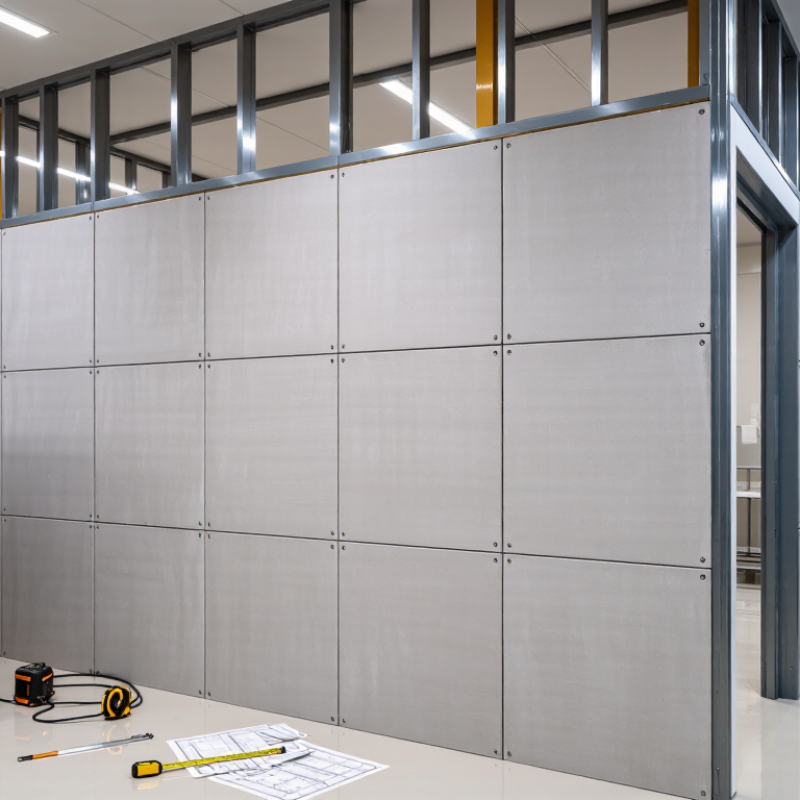
Installation demands careful detailing. Frames must support the panel’s high weight, especially around doors and service openings. Panels should be tightly butted, with joints staggered between layers when multiple layers are specified. Seams, corners, electrical boxes, ducts, and pipe penetrations need compatible shielding treatment. A small gap can undermine an otherwise solid wall. The weak point is often the doorway.

Installers should verify screw spacing, joint treatment, and panel orientation against the engineering specification. After construction, radiation measurements should be performed during representative operation. A visually perfect room may still have leakage. That possibility deserves honest attention. Barite drywall also creates dust and handling challenges, so cutting, lifting, and cleanup require controlled site practices.

Common Applications in Medical and Industrial Facilities

What Is Barite Drywall Radiation Shielding?

Common Applications in Medical and Industrial Facilities

Barite drywall is a dense gypsum panel containing barium sulfate aggregate. Its weight reduces the transmission of diagnostic X-rays and some gamma radiation. The material is often installed as wall lining, ceiling panels, control-room partitions, or door surrounds. Medical facilities use it around radiography, fluoroscopy, dental imaging, and computed tomography rooms. Industrial sites may apply it near inspection laboratories and enclosed radiography areas.

It is not magic.

The International Atomic Energy Agency’s Safety Reports Series No. 47 states that shielding design must consider workload, distance, beam direction, occupancy, and room layout. NCRP Report No. 147 also treats these factors as essential, rather than recommending one universal wall thickness.

Under IAEA General Safety Requirements Part 3, public exposure limits are 1 mSv per year, while occupational exposure is limited to 20 mSv per year averaged over five years.

These figures guide protection planning, but they do not replace a site-specific calculation.

In practice, installers should check panel density, joints, penetrations, fasteners, and service openings. A small unshielded gap can weaken an otherwise heavy wall. The details matter.

Barite drywall may simplify construction, yet it can become difficult to lift, cut, and align safely. I would not treat a standard thickness as automatically suitable.

Equipment output, weekly workload, nearby occupancy, and local approval requirements can change the design. Regular surveys after installation provide stronger evidence than visual inspection alone.

Safety, Performance, and Maintenance Considerations

What Is Barite Drywall Radiation Shielding?

Barite drywall uses gypsum panels loaded with barium sulfate to reduce scattered X-ray radiation. Its protection depends on panel thickness, radiation energy, workload, and room layout. NCRP Report No. 147 stresses that shielding design must consider occupancy, distance, and use factors, not material thickness alone.

Safety begins with a qualified shielding assessment. ICRP Publication 103 recommends limiting occupational exposure to 20 mSv per year, averaged over five years, while public exposure is generally limited to 1 mSv per year. These values are design references, not permission to ignore local requirements. Every project needs documented calculations.

Performance can change at joints, corners, doors, outlets, and service penetrations. Small gaps matter. A continuous backing layer and carefully overlapped seams reduce weak points. However, barite panels are heavy, and wall framing may need structural review. This detail is sometimes missed.

Maintenance is practical but demanding. Inspect damaged surfaces, drilled openings, loose joints, and relocated equipment after renovation. Use approved repair materials with equivalent shielding properties. Do not assume ordinary gypsum compound restores protection. IAEA Safety Reports Series guidance also supports reassessment when workload, room use, or equipment changes.

The uncomfortable truth is that a clean wall is not proof of safe shielding. Documentation, inspection records, and radiation surveys provide stronger evidence.