7 Best Bow Type Laying Up Machines for Cable Production
Cable demand is rising as grids expand, renewable projects connect, and utilities replace aging infrastructure. The International Energy Agency’s 2023 report, Electricity Grids and Secure Energy Transitions, estimates that 80 million kilometres of electricity grids must be added or refurbished by 2040. That is roughly the length of today’s entire global grid. This buildout puts pressure on cable manufacturers to improve throughput without sacrificing consistent conductor geometry or insulation quality.
A Bow Type Laying Up Machine brings multiple insulated cores or conductors together under controlled tension and lays them into a stable cable structure. In production, small differences matter: uneven payoff tension, an unsuitable lay length, or a mismatched take-up reel can create defects and costly stoppages. The fastest line is not always the best choice. It may be too large, too complex, or poorly matched to a factory’s product mix. A useful comparison should consider conductor range, cage configuration, maximum line speed, tension control, changeover time, automation, and after-sales support. These details are often less impressive than a headline speed, but they shape daily output.
This guide reviews seven bow-type laying-up machines for cable production, from practical configurations for standard work to higher-capacity options for demanding applications. Specifications vary by manufacturer and material, so buyers should confirm performance using their own conductor sizes and production targets. A brochure cannot replace a trial.
Understanding Bow-Type Laying-Up Machines in Cable Production
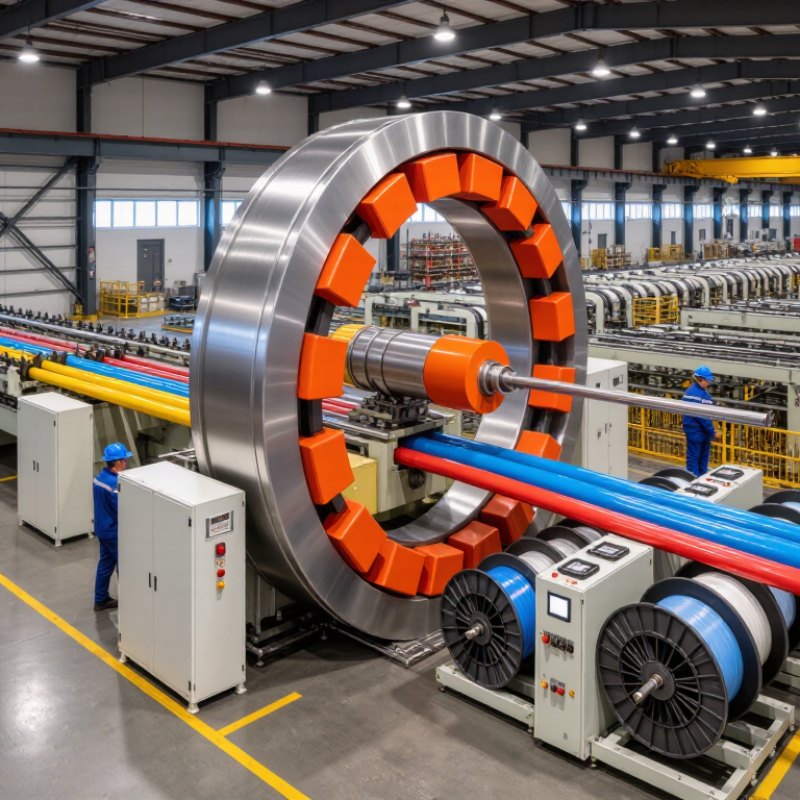
A bow-type laying-up machine brings insulated conductors or cable cores together with a controlled helical twist. Its rotating bow, pay-off reels, capstan, and take-up system must work in balance. The lay length determines how far the cable advances during each twist; changing it can affect flexibility, diameter, and stability. Small errors matter. Operators should check reel tension, bow speed, and take-up alignment against the product specification. Uneven tension may leave a core slack on one side, even when the finished cable looks acceptable at a glance.
Demand forecasts offer useful context, but they are not machine-performance data. The International Energy Agency’s Electricity Grids and Secure Energy Transitions (2023) estimates that annual grid investment needs to rise from about USD 300 billion to more than USD 600 billion by 2030. Its Electricity 2024 report forecasts global electricity demand growth averaging 3.4% annually through 2026. Both trends point to ongoing pressure on cable manufacturing capacity. For a production line, compare required cable diameter, core count, lay-length range, and changeover time before selecting equipment. A neat specification sheet can still miss the awkward part: reel changes and operator access. Those details deserve a trial run, not an assumption.
How Bow-Type Machines Lay Up Cable Cores
A bow-type laying-up machine brings insulated cores together around a central element. Its rotating bow carries the cores around the machine axis, while guides and closing dies form a compact cable core. The capstan pulls the assembly forward. Bow rotation and line speed determine the lay length: faster rotation or slower haul-off produces a tighter lay. Small details matter. Uneven payoff tension can leave one core slack, creating visible gaps or a lumpy surface. Operators therefore monitor tension, core alignment, and finished diameter during setup, not only after a full reel is complete.
The demand context is growing. The IEA’s Electricity Grids and Secure Energy Transitions report (2023) says annual grid investment must rise from about USD 300 billion today to over USD 600 billion by 2030. Its Renewables 2023 report forecasts 2,400 GW of renewable capacity additions worldwide during 2022–2027. These figures do not specify machine demand, but they show why consistent cable-core production matters. For each job, technicians match the bow’s speed, payoff tension, and die size to core materials and diameter. The ideal setting is not always obvious; a short trial run can reveal problems that calculations miss.
Key Criteria for Comparing Laying-Up Machines
A bow-type laying-up machine should match the cable structure, not just the planned production speed. Check the bow diameter and allowable conductor size against the products you actually make. A larger bow may handle heavier cores, but it can also need more floor space and power. Confirm the machine’s bobbin capacity, loading method, and compatibility with your existing pay-off and take-up equipment. Small mismatches can cause frequent stops.
Tension control deserves close attention. Uneven tension can leave strands loose in one section and overly tight in another. Ask how operators set tension and whether adjustments remain stable as bobbins empty. Review the available lay lengths and speed range, then compare them with your specifications. Noise, vibration, guarding, and access for routine maintenance matter too. A fast machine is not automatically a productive one; setup time may offset its rated output. I would still verify performance with a representative cable sample, since brochures cannot reveal every shop-floor issue.
Tips: Record actual changeover time, scrap, and cable quality during a trial run. Inspect the finished lay under consistent lighting. Check whether operators can reach wear parts without awkward repositioning. Keep one question open: will the machine suit next year’s product mix, not only today’s?
Seven Bow-Type Machines for Cable Production
Bow-type laying-up lines are not one-size-fits-all. A practical shortlist covers seven configurations: single-bow stranders, double-bow twisters, planetary bow machines, high-speed lines, compact-footprint lines, heavy-duty lines, and servo-controlled systems. These are useful selection categories, not a universal industry classification. Some designs overlap. The right choice depends on conductor size, strand count, target lay length, and required output.
The International Energy Agency’s 2023 report, Electricity Grids and Secure Energy Transitions, says annual grid investment needs to exceed USD 600 billion by 2030, more than doubling current levels. This is a grid investment estimate, not a cable-sales forecast. Still, it signals why manufacturers are reviewing capacity and production flexibility. A double-bow line may suit faster twisting operations, while a heavy-duty configuration can handle larger conductors. Actual performance depends on tooling, tension control, and material handling.
A neat speed figure can mislead. Check the machine under your own wire diameters and spool weights. Watch the bow pass, listen for vibration, and inspect lay consistency across a full production run. Servo control can improve repeatability, but it cannot fix poor setup. I would also compare changeover time and maintenance access; they are easy to overlook during a showroom test. The perfect configuration may not exist. One trade-off usually remains.
7 Bow-Type Machine Operating Scenarios for Cable Production
The chart compares calculated theoretical lay lengths at different line speeds. Lay length is estimated as line speed divided by bow rotation speed, assuming one lay per revolution. These are illustrative operating scenarios, not measured specifications or a ranking of machines.
Choosing a Machine for Specific Cable Manufacturing Needs
Choosing a bow-type laying-up machine starts with cable construction, not catalogue speed. Count the insulated cores, note their diameters, and define the required lay length. A machine suited to a small control cable may struggle with heavier power cores. Check the bow’s working diameter and maximum take-up reel capacity against current and planned products. Leave room for changeovers. Small details matter.
Production goals also shape the choice. Higher bow speed can raise output, but only when tension control keeps each core steady. Ask how the machine handles different spool sizes, payoff braking, and emergency stops. Inspect access to guides and wear parts; awkward threading can add minutes to every setup. Request a trial using representative cable, then check lay consistency, surface marks, and measured output. One trial is not proof, though.
Tips: Record core tension, bow speed, and lay length during trials. Compare actual shift output, not the advertised maximum. If product sizes vary widely, prioritize quick adjustments and clear settings over peak speed. Ask operators to review the layout; they may spot handling issues early.