
Posts
10 Best Lithium RV Batteries for Every Budget
Choosing a lithium RV battery is not just about buying the largest capacity you can afford. You need a battery that fits your travel style, electrical system, and budget. A weekend camper may value a compact, affordable option. A full-time traveler might need more usable energy, dependable cold-weather protection, and room to expand. Details matter. A battery’s amp-hour rating, built-in battery management system, warranty, and charging compatibility all affect how it performs on the road.
RV electrical educator Mike Sokol’s practical guidance can be paraphrased this way: check how the battery works with the whole charging system, not just its label. This is a paraphrase, not a verified verbatim quotation. That distinction matters when comparing advice. A well-matched lithium rv battery can power lights, a refrigerator, and other essentials with less weight than many lead-acid alternatives. But lithium is not automatically the right choice for every rig. Installation limits, temperature, and existing chargers can change the equation. Sometimes the overlooked charger is the problem.
This guide compares ten options across different budgets and use cases. It looks at capacity, protection features, warranty terms, and practical trade-offs. No single model wins for everyone. Prices and specifications can change, so confirm current details before purchasing. A little skepticism helps.
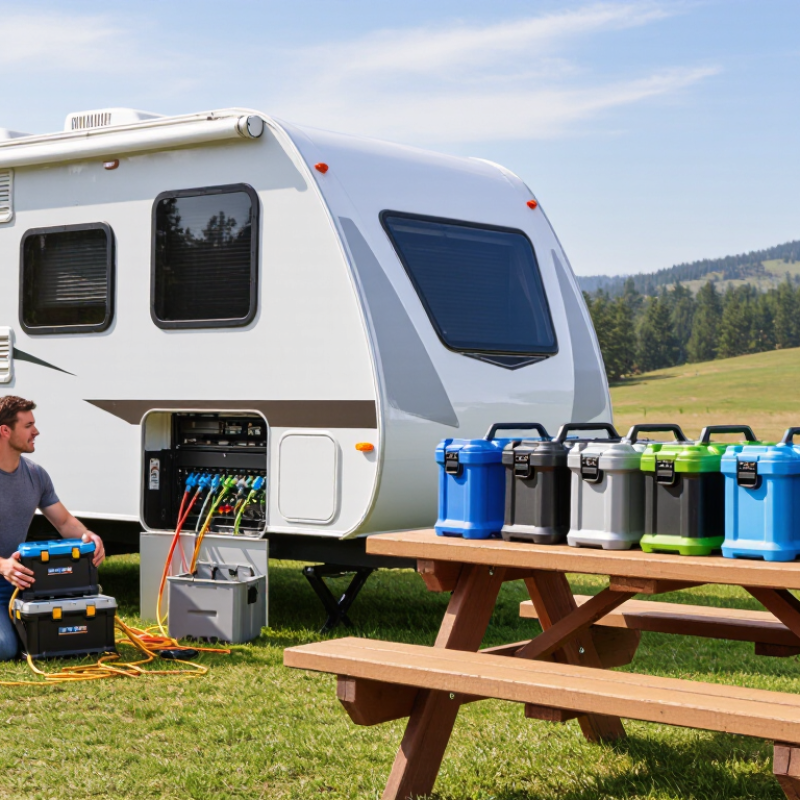
Establish RV Battery Types and the 1.28 kWh Benchmark for 12.8V, 100Ah
RV house batteries usually use lead-acid or lithium chemistry. Lead-acid options include flooded and sealed AGM batteries; flooded designs need routine water checks. Lithium RV batteries commonly use lithium iron phosphate, or LiFePO4. They often weigh less than comparable lead-acid batteries, but cost more upfront. A battery’s chemistry affects charging needs, weight, maintenance, and how much capacity is practical to use.
A 12.8V, 100Ah battery has a nominal energy rating of 1.28 kWh: voltage multiplied by amp-hours. That is the label figure. Not all is usable. The battery management system may limit discharge, while cold temperatures and inverter losses can reduce energy available to appliances. As a simple estimate, a steady 100-watt load would draw 1.28 kWh in about 12.8 hours under ideal conditions. Real use is usually shorter.
Compare batteries by usable watt-hours, not amp-hours alone. A 100Ah lead-acid battery and a 100Ah LiFePO4 battery may not deliver the same practical energy. Check the manufacturer’s recommended discharge limits and confirm your converter or solar charge controller supports the battery’s chemistry. Also consider the loads you actually run: a brief microwave session differs greatly from overnight heating or refrigeration. I would leave some margin in the estimate; appliance use rarely follows a neat spreadsheet.
Compare Usable Capacity and Manufacturer-Rated Cycle Life at 80% Depth of Discharge
Usable capacity turns a battery label into a practical estimate. A 12.8-volt, 100-Ah battery stores about 1.28 kWh nominally. At 80% depth of discharge, that leaves 80 Ah, or roughly 1.02 kWh, before inverter losses. A 200-Ah model provides about 1.60 kWh under the same assumption. The calculation is simple. Real output can be lower when cold temperatures, high loads, or wiring losses intervene.
Cycle-life ratings need equal care. Compare each maker’s stated cycles at 80% depth of discharge, not figures tested at a shallower discharge. Also check the stated temperature and charging conditions. NREL’s Battery Lifetime Analysis and Simulation Tool documentation models battery aging against operating conditions, reinforcing that cycle claims are not universal guarantees.
For scale, a hypothetical 100-Ah battery rated for 2,000 cycles delivers about 2,048 kWh of theoretical lifetime throughput at 80% discharge; a 4,000-cycle rating suggests about 4,096 kWh.
These are estimates, not promises. Calendar aging still matters. And honestly, the comparison can feel incomplete when test conditions are missing.
Match Battery Capacity to RV Loads, Inverter Draw, and Charging Needs
Choose an RV battery by measuring what you use, not by guessing from its size. List each appliance’s wattage and daily run time, then multiply watts by hours to estimate energy use. A 60-watt fan running eight hours uses about 480 watt-hours. Small loads add up. Leave room for conversion losses and unexpected cloudy days; a tidy estimate can still miss real-world use.
Check inverter demand separately. A 1,000-watt AC appliance may draw roughly 90 amps from a 12-volt battery when inverter losses are included. Confirm the battery’s continuous and surge ratings can support that draw. Also compare capacity with your charging options, including solar, shore power, or an alternator. Charging speed depends on charger output and battery limits, not capacity alone. Follow the battery maker’s temperature and charging guidance, especially in cold weather.
Tips: Track your actual use for a few days with a meter or monitor. Size capacity for your typical routine, then check that charging can replace your daily consumption. If the numbers feel tight, reassess the loads; adding capacity is not always the easiest fix.
| Pick | Battery Profile | Nominal Capacity | Nominal Energy | Estimated Usable Energy | Typical Continuous BMS Output | Practical Inverter Match | Suggested Charge Current | Indicative U.S. Price Range | Best Fit |
|---|---|---|---|---|---|---|---|---|---|
| 1 | Compact entry-level LiFePO₄ | 12.8 V, 50 Ah | 640 Wh | About 576 Wh | 50 A | Up to about 500 W continuous | 10–25 A | $100–$180 | Small trailers, lights, phones, fans, and modest DC loads |
| 2 | Lightweight weekend setup | 12.8 V, 75 Ah | 960 Wh | About 864 Wh | 75 A | Up to about 700 W continuous | 15–35 A | $150–$250 | Weekend camping with a 12 V refrigerator and everyday electronics |
| 3 | Budget 100 Ah house battery | 12.8 V, 100 Ah | 1,280 Wh | About 1,152 Wh | 100 A | Up to about 1,000 W continuous | 20–50 A | $180–$350 | Basic off-grid use with lights, refrigeration, fans, and device charging |
| 4 | 100 Ah higher-output configuration | 12.8 V, 100 Ah | 1,280 Wh | About 1,152 Wh | 150 A | Up to about 1,500 W continuous, if wiring and inverter allow | 20–50 A | $250–$450 | Compact battery spaces where a stronger BMS output is useful |
| 5 | Mid-size extended-stay battery | 12.8 V, 150 Ah | 1,920 Wh | About 1,728 Wh | 150 A | Up to about 1,500 W continuous | 30–75 A | $300–$550 | Longer trips with refrigeration, lighting, and intermittent small-appliance use |
| 6 | Common 200 Ah all-around configuration | 12.8 V, 200 Ah | 2,560 Wh | About 2,304 Wh | 200 A | Up to about 2,000 W continuous | 40–100 A | $350–$700 | Full-time or frequent off-grid use with a moderate inverter load |
| 7 | 200 Ah lower-current, value configuration | 12.8 V, 200 Ah | 2,560 Wh | About 2,304 Wh | 100 A | Up to about 1,000 W continuous | 40–100 A | $350–$650 | High energy capacity for DC loads without frequent high-wattage inverter use |
| 8 | Large-capacity single-battery setup | 12.8 V, 280 Ah | 3,584 Wh | About 3,226 Wh | 200 A | Up to about 2,000 W continuous | 55–140 A | $500–$900 | Long off-grid stays and higher daily energy use |
| 9 | High-capacity 300 Ah configuration | 12.8 V, 300 Ah | 3,840 Wh | About 3,456 Wh | 200 A | Up to about 2,000 W continuous | 60–150 A | $600–$1,000 | Large RV loads where extended runtime matters more than a small footprint |
| 10 | High-capacity 400 Ah bank | 12.8 V, 400 Ah | 5,120 Wh | About 4,608 Wh | 200 A per battery or bank limit | Up to about 2,000 W continuous at a 200 A bank limit | 80–200 A, subject to battery and charger limits | $800–$1,500 | High daily energy demand, subject to space, weight, and charging capacity |
| Planning notes: Profiles are generic LiFePO₄ examples, not specific products; actual specifications and prices vary by model and seller. Usable energy is estimated at 90% of nominal energy. Inverter matches are approximate, based on 12.8 V batteries and roughly 90% inverter efficiency; startup surges, cable size, temperature, and BMS limits can reduce available output. Confirm the battery’s continuous and peak discharge ratings, charger voltage profile, low-temperature charging protection, and the RV’s wiring limits before installation. Charging-current figures are suggested planning ranges, not guaranteed battery limits. | |||||||||
Rank 10 Lithium RV Batteries by Budget, Warranty, and Safety Certifications
This ranking weighs purchase cost, written warranty, and documented safety testing, not capacity alone. Rank 1 goes to an entry-level 100Ah battery with clear warranty terms and verifiable cell protection. Rank 2 favors a similar budget unit with stronger support documentation. Rank 3 is a mid-priced 100Ah option with a longer stated warranty. Rank 4 suits buyers needing a compact case and published temperature limits. Rank 5 prioritizes a built-in battery management system and traceable safety certification. Details matter.
Rank 6 is a higher-capacity model with transparent cycle-life conditions. Rank 7 offers expandable capacity, though its warranty may exclude mixed battery ages. Rank 8 favors cold-weather protection and clear charging guidance. Rank 9 targets frequent travelers who value service access over the lowest price. Rank 10 is a premium, high-capacity choice; it makes sense only when the extra storage is genuinely useful. These are buying profiles, not guarantees about every product in each price class.
Before choosing, compare warranty length, exclusions, and who handles claims. A long warranty can still be narrow. Check the paperwork. Confirm that any claimed safety certification applies to the exact battery model, not just a component or factory. Look for documented overcharge, short-circuit, and temperature protections. Then check that the battery fits the RV’s charging system and mounting space. I would not rank a product highly on marketing language alone; missing test records should lower its place.
Verify BMS Current Limits and the Typical 14.2–14.6V LiFePO4 Charge Range
A lithium RV battery’s amp-hour rating does not tell the whole story. Check the battery management system’s continuous discharge limit, not just its brief surge rating. A 2,000-watt inverter can draw well over 160 amps from a 12-volt bank before conversion losses. That number matters. If the BMS limit is lower, it may shut the battery off under heavy load, even when plenty of capacity remains.
Charging voltage needs the same careful check. Many 12-volt LiFePO4 batteries specify a charging range around 14.2–14.6 volts, but the battery manual should set the final target. Confirm that the converter or solar charge controller can use a lithium profile and does not apply an unsuitable equalization cycle. Small details count. Measure voltage at the battery terminals during charging; long cable runs and loose connections can affect what you see.
For a budget comparison, look beyond the purchase price. A lower-cost battery may have a BMS limit that does not suit an existing inverter, while a higher-capacity unit may still be a poor match. Check charging and discharge limits against your actual loads, including the refrigerator, pump, and inverter. It is tempting to size everything from a single headline number. That shortcut can miss how the RV is really used, so leave some margin and verify the specifications before buying.
10 Best Lithium RV Batteries for Every Budget
Typical 12V LiFePO₄ charging reference: check the battery maker’s specifications and verify BMS current limits before choosing or charging a battery.
A common charging-voltage range for 12V LiFePO₄ batteries is 14.2–14.6 V. The exact setting and allowable charge current vary by battery; confirm both in its documentation. BMS current limits are not shown because they are model-specific.
