
Posts
How to Choose a Flexible LED Work Light in 2026?
A flexible work light can make a cramped repair easier, but flexibility alone does not guarantee useful light. In 2026, buyers can choose from magnetic, clip-on, rechargeable, and bendable designs. The right Flexible Led Work Light should suit the task, the workspace, and the way you actually work. A mechanic reaching behind an engine needs a different setup from a homeowner checking a dark cupboard. Small details matter. A strong magnet may hold securely on a steel frame, while a stable base can be more useful on wood or plastic.
Look beyond brightness claims. Check whether the beam lights a close work area evenly, whether the arm stays in position, and whether the controls are easy to use with gloves. Battery runtime, charging options, heat, and resistance to dust or splashes also deserve attention. Product specifications can help, but real performance depends on use conditions; a high lumen figure cannot tell you how well light reaches a narrow gap. I have found that awkward switches and slipping mounts can matter more than an impressive feature list. That is easy to overlook.
This guide explains how to compare light output, mounting options, battery life, durability, and value before choosing. It also considers where flexible designs can fall short. No single light suits every job. A practical choice is one that stays put, directs light where needed, and remains comfortable during repeated use.
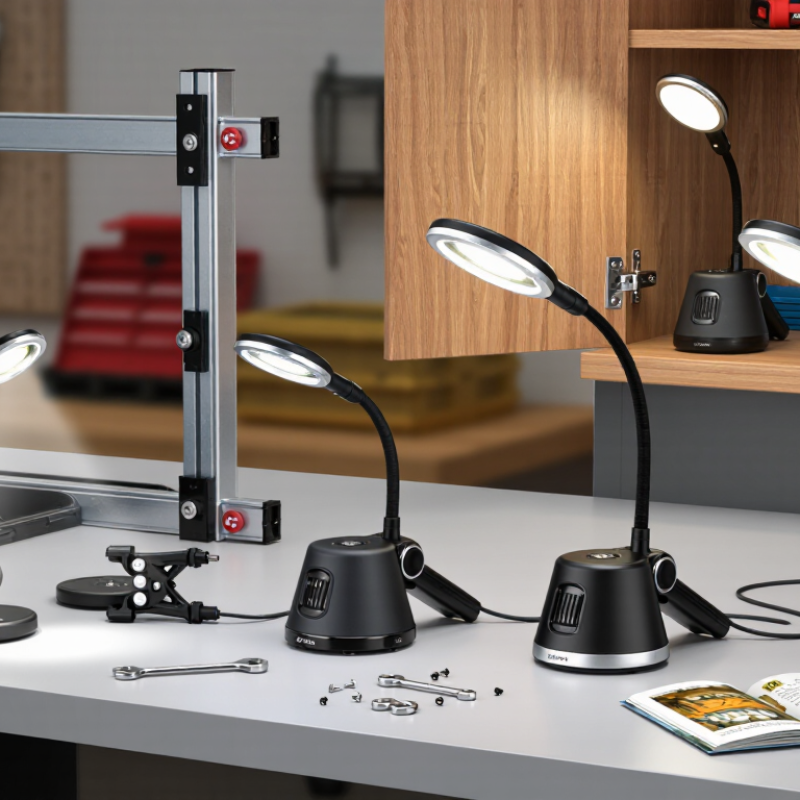
Define the Task: Compare Rated Lumens, Beam Spread, and Work Distance
A lumen rating describes total light output, not how much reaches a bolt head. For close repair work, a modest lamp with a focused beam may show threads more clearly than a higher-output floodlight. Check whether the rating applies at full power and whether heat or battery use reduces output over time. Numbers need context.
Beam spread determines how much area is lit at once. A narrow beam can reach into a recess, but may leave nearby parts dark. A wider beam suits work under a sink or across a bench, though its center can appear less bright. Flexible heads help direct light around hands and tools, but a hinge may drift at an awkward angle. Test the position you expect to use.
Measure your usual work distance before comparing lights. At 30 centimeters, a beam may make a small fastener easy to see; at one meter, it may spread thinly across a panel. If available, compare lux at the task distance, using the same surface and angle. A white-wall test can mislead: reflective paint may make a beam seem stronger than it feels inside a dark cabinet. I would not treat that result as decisive. The actual work angle matters.
Assess Color Quality: Consider CRI Ra ≥80 for General Visual Tasks
When choosing a flexible LED work light in 2026, treat CRI Ra as a useful filter, not a complete color verdict. The CIE 13.3-1995 method averages color-rendering results from eight test-color samples against a reference source. For general tasks such as reading wiring labels, sorting fasteners, or checking a painted surface, Ra ≥80 is a practical baseline. It does not guarantee perfect color. Details matter.
For red wire insulation, colored cable jackets, or finish matching, check whether the specification also provides R9 or TM-30 data. The IES TM-30-20 technical report evaluates 99 color samples and reports fidelity and gamut metrics, offering a broader view than Ra alone. A high Ra value can still hide weak rendering of saturated colors. Try the light on the actual work surface, at your usual distance and angle. Compare a red wire and a neutral gray object under the beam. Phone photos can mislead because automatic white balance changes color. A bendable neck helps aim the beam, but it cannot improve color quality.
How to Choose a Flexible LED Work Light in 2026?
Assess color quality: consider CRI Ra ≥80 for general visual tasks.
CRI Ra is scored on a 0–100 scale; higher values generally indicate more faithful color rendering. A rating of 80 is a common baseline for general visual tasks, while 90 or higher is often preferred when color distinctions matter. These are selection guidelines, not guarantees of identical color appearance.
Check Flexibility: Compare Arm Reach, Pivot Range, and Mount Stability
How to Choose a Flexible LED Work Light in 2026?
Check Flexibility: Compare Arm Reach, Pivot Range, and Mount Stability
A flexible work light should place the beam where your hands need it, without forcing an awkward stance. Measure the distance from the mounting point to your work area before choosing an arm length. Extra reach sounds useful, but a long arm may sag or wobble when extended. Check how firmly it holds a lamp head, especially when aimed downward at a bench or engine bay. Small details matter.
Pivot range determines whether you can direct light around shelves, pipes, or machine parts. Look for joints that move smoothly but stay put when released. If possible, test the light in several positions rather than judging it from a product photo. Mount stability matters just as much: a clamp needs a secure edge, while a magnetic base needs a clean, flat steel surface. A flexible arm cannot compensate for a mount that shifts under light pressure. It is easy to overvalue reach and overlook this trade-off.
Decode Protection: IEC 60529 IP65 Means Dust-Tight and Water-Jet Resistant
When choosing a flexible LED work light in 2026, check what IP65 actually promises. Under IEC 60529, “6” means dust-tight: dust should not enter the enclosure during the specified test. “5” means protection against water jets from a nozzle under defined test conditions. That matters. IP65 does not mean the lamp can be submerged, pressure-washed at close range, or left in standing water.
On a workshop floor, picture grinding dust settling around the lamp head or rain hitting a jobsite bench. An IP65-rated light is designed for these exposures, but the complete assembly must meet the rating. Inspect the lens seam, switch, charging port, cable gland, and flexible neck joint; one poorly sealed opening can compromise protection. A rubber flap that looks snug may loosen after repeated bending. Small detail.
Check whether the rating covers the complete light, including its battery compartment and connectors, rather than just the outer housing. Follow the care instructions, and dry wet connectors before charging. Flexibility helps when aiming light beneath a vehicle, yet repeated twisting can stress seals and wiring. IP ratings describe tested conditions, not every accident in the field. I would not treat IP65 as a substitute for regular inspection.
Compare Runtime and Durability: Review ANSI/PLATO FL 1 Test Ratings
When comparing flexible LED work lights, treat runtime as a measured result, not a promise of all-night brightness. ANSI/PLATO FL 1-2019 defines runtime from the point when output is measured, 30 seconds after switch-on, until it falls to 10 percent of that initial level. A light rated for 10 hours may therefore spend its final hours much dimmer. Check the test conditions and battery configuration, then compare the runtime rating with your actual shift length. Small detail, big difference.
Durability ratings need the same careful reading. FL 1 impact resistance reports a drop-test height in meters, while water resistance uses an IPX rating under specified test conditions. These figures help compare products, but they do not prove that every flexible joint, cable, or connector handles repeated bending, grit, and wet work equally well. Look for test documentation, not only a number on packaging. In a workshop, inspect the gooseneck after repeated repositioning and check whether the light stays aimed at a bolt or panel. That practical check is easy to overlook. No standard rating captures every rough shift.
How to Choose a Flexible LED Work Light in 2026? — Compare Runtime and Durability: Review ANSI/PLATO FL 1 Test Ratings
| Comparison Point | What the Rating or Specification Means | How to Compare Work Lights | Practical Buying Guidance |
|---|---|---|---|
| Runtime | ANSI/PLATO FL 1 runtime is the time a light operates before its output falls to 10% of the measured initial output under the specified test conditions. | Compare runtime figures only when the tested mode, battery configuration, and test basis are alike. A high-output mode will generally run for less time than a low-output mode. | Choose a light with a published runtime for the mode you expect to use. Treat runtime as a standardized comparison, not a guarantee of identical results in every jobsite condition. |
| Impact Resistance | FL 1 impact resistance is reported as a drop height in meters. It indicates the height from which a tested light can withstand drops under the standard’s test procedure. | Compare the stated height and confirm that the product listing identifies it as an FL 1 impact-resistance result. Do not assume a higher rating means the light is resistant to every type of impact. | For frequent handling or work around hard floors, prioritize a published impact rating and a housing designed to protect the light’s moving and electrical parts. |
| Water Resistance | FL 1 water-resistance information describes performance under defined water-exposure testing. It does not, by itself, establish resistance to dust, chemicals, or all forms of moisture. | Check the exact water-resistance marking and its test conditions. If a separate IP code is listed, read that code independently rather than treating it as interchangeable with an FL 1 result. | Match the stated protection to the work environment. For outdoor or wet-area use, look for clearly documented water protection and follow the manufacturer’s limits for charging and storage. |
| Flexible Positioning | Hinges, pivots, magnetic bases, hooks, and clamps are useful design features, but they are not FL 1 performance ratings. | Check the advertised adjustment range and whether the light can remain stable in the positions needed for your task. Consider the surfaces and mounting points available at the jobsite. | Choose a base or attachment system that suits your work area. A flexible head is most useful when it can be aimed without the light tipping or needing to be held. |
| Battery and Charging | Battery capacity, recharge time, replaceability, and charging method are product specifications, not substitutes for a standardized runtime test. | Compare runtime together with battery details and charging information. Check whether the stated runtime applies to a particular brightness setting or battery pack. | For long shifts, consider whether the battery can be replaced or recharged during breaks, and whether the light can operate while charging if that feature is important. |
| Brightness and Beam | Light output and beam characteristics describe how much light is produced and how it is distributed. They do not alone indicate runtime or durability. | Compare output figures on equivalent modes and consider whether the beam is broad enough for close work. A higher output setting may reduce operating time. | For workbench and repair tasks, prioritize useful, even illumination and a controllable output mode rather than selecting by maximum brightness alone. |
| Test Conditions and Documentation | FL 1 figures are standardized test results; actual performance can vary with temperature, battery condition, settings, and use. | Look for the rating, test standard, mode, and relevant conditions in the product documentation. Avoid comparing a tested figure with an undefined marketing estimate. | Use published test information to narrow choices, then confirm that the light’s battery, mounting, and protection features fit the conditions in which it will be used. |
Comparison note: ANSI/PLATO FL 1 provides standardized methods for comparing specified flashlight and portable-light performance. Ratings should be read alongside the product’s stated test conditions; they do not guarantee performance in every real-world situation.
