
Posts
How to Choose Agricultural Bearings in 2026?
Agricultural machinery rarely works in clean, steady conditions. A bearing inside a combine may face dust, vibration, crop residue, and sudden load changes in one shift. A planter’s bearings can encounter moisture and soil, while a mixer may need frequent washdowns. These details matter more than a catalog headline. Choosing an Agricultural Bearing for 2026 means matching its design to the machine, the environment, and the maintenance actually available.
The wider operating context is demanding. FAO’s AQUASTAT database attributes about 70% of global freshwater withdrawals to agriculture, a reminder that water exposure is common across many farming systems. FAO’s 2022 report, The State of Food and Agriculture: Leveraging Automation in Agriculture, also examines how automation is changing farm operations. Neither report picks a bearing for a specific machine. That distinction matters. For a sound choice, compare radial and axial loads, speed, shaft alignment, sealing, lubricant, and expected service life. ISO 281 provides a recognized method for calculating rolling-bearing rating life, but real contamination and poor lubrication can shorten performance. The numbers are useful. They are not the whole story.
Before selecting a sealed unit or a relubrication schedule, check the manufacturer’s load data and the machine’s actual service conditions. A bearing that fits the shaft may still fail early if its seal cannot keep out fine dust or water. And field maintenance can be inconsistent. That deserves honest attention, not an idealized plan.
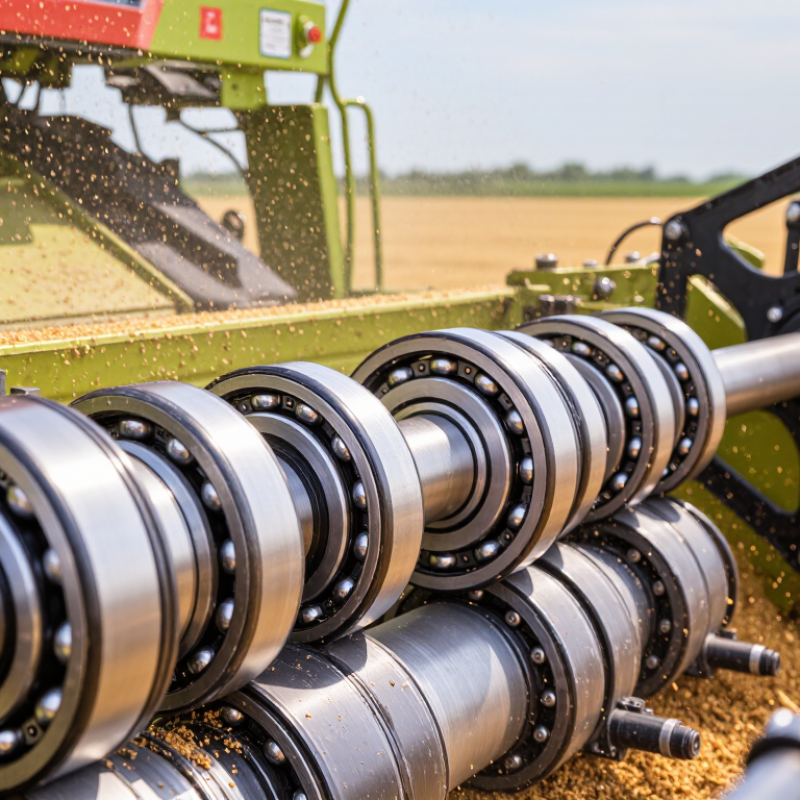
Assess the Machine, Crop, and Operating Conditions
Start with the machine, not a catalogue. Check the shaft diameter, housing space, load direction, and operating speed. A planter working through uneven ground may face repeated shocks, while a conveyor often runs steadily for long periods. Match the bearing’s load capacity and speed rating to the actual duty cycle, including short periods of heavy strain. Dimensions alone are not enough. A bearing that fits can still be poorly suited to the work.
Then consider the crop and the conditions around it. Fine grain dust can work past weak seals; damp soil and frequent washing can create corrosion risks. Choose sealing and lubrication arrangements for the real exposure, not an idealized shed. Also note temperature swings, vibration, and how often maintenance is practical during the season. Downtime matters. Confirm that the lubricant suits the bearing and the machine’s service schedule. Check mounting fits and alignment, since installation errors can shorten service life even when the bearing is correctly specified. Field conditions are messy, and a clean test result may not tell the whole story. Keep notes on failures, inspection findings, and seasonal changes; revise the choice when those records point to a mismatch.
How to Choose Agricultural Bearings in 2026?
Assess the machine, crop, and operating conditions
Soil-working equipment commonly faces abrasive contamination and shock loads; planting equipment needs reliable operation in dusty conditions; harvest machinery can encounter crop debris and moisture; balers experience substantial cyclic loading. Prioritize the conditions your machine actually faces, then confirm bearing loads, speed, fit, and sealing requirements with the equipment specifications.
Scores are qualitative screening priorities from 1 (lower) to 5 (critical), not measured field data or bearing performance ratings.
Identify Bearing Loads, Speed, and Required Dimensions
Start with the actual load path, not just the machine’s rated capacity. A cultivator wheel may see steady radial load, while a combine’s shaker drive adds vibration and shock. Record radial and axial loads, duty hours, and peak impacts. ISO 281:2007 calculates basic rating life using L10 = (C/P)p million revolutions: L10 represents 90% reliability, with p = 3 for ball bearings and 10/3 for roller bearings. Here, C is basic dynamic load rating and P is equivalent dynamic load. Useful data. But a clean calculation can miss field shock.
Next, check operating speed against the bearing’s permissible speed, then confirm dimensions against the shaft and housing. Measure shaft diameter, housing bore, bearing width, shoulder space, and any seal clearance. A few millimetres can decide whether the assembly fits. ISO 15:2017 specifies boundary dimensions for several radial bearing types, but it does not choose the correct fit for every dusty, wet, or vibrating application. Check the machine’s service conditions and the bearing supplier’s fit and speed guidance. Dirt on a shaft can distort a measurement; recheck it. Record the required internal clearance too, since heat and tight fits can reduce it during operation.
Choose a Bearing Type for the Application
How to Choose Agricultural Bearings in 2026?
Choose a Bearing Type for the Application
Start with the load, movement, and working environment—not the machine name. A planter disc often needs a compact bearing that handles steady rotation and moderate radial loads. A combine conveyor may face heavier loads, vibration, and brief impacts. Those conditions can favor different designs, even on similar equipment.
Deep-groove ball bearings suit many applications with mainly radial loads and some axial force. Spherical roller bearings can accommodate heavier loads and limited shaft misalignment. Tapered roller bearings handle combined radial and axial loads, but need suitable adjustment and mounting. For dusty, damp areas, sealed bearing units can help keep contaminants away. Seals still need inspection. Mud finds a way.
Check speed, shaft fit, housing space, and lubrication access before selecting a type. A bearing that fits on paper may run hot if alignment is poor or grease cannot reach it. Note how the machine actually operates: dusty harvest days differ from wet, slow fieldwork. Measurements in the field are not always neat, and that is worth admitting. Recheck shaft wear and housing condition before replacing a bearing; otherwise, the new part may inherit the old problem.
Compare Seals, Materials, and Lubrication Options
In 2026, choose agricultural bearings by matching seals, materials, and lubrication to the messiest working day, not an ideal test bench. FAO’s AQUASTAT data puts agriculture at about 70% of global freshwater withdrawals, a reminder that moisture is routine in many operations. Mud, fertilizer residue, and pressure washing can work past a poorly matched seal. Contact seals help retain grease and block debris, but add friction; labyrinth seals run with less contact, yet may offer less protection from direct water spray. No seal is perfect. Check the actual washdown pattern and shaft speed.
Standard hardened bearing steel suits many demanding loads. In persistently wet or corrosive areas, stainless grades may reduce rust risk, but confirm their load capacity for the specific bearing design. For grease, follow the bearing maker’s stated viscosity and temperature range, then set relubrication intervals around dust, moisture, and operating hours. Too much grease can raise heat. Too little invites wear. ISO 281:2007 provides a basic method for calculating bearing rating life, but field shock and contamination still matter. A catalog choice can look right and fail in a muddy field; inspect seals and grease condition during the season, and revise the interval when evidence points elsewhere.
| Decision area | Option | Key advantages | Trade-offs and limitations | Common agricultural conditions | Selection checks |
|---|---|---|---|---|---|
| Seals and shields | Contact elastomer seal | Provides a physical contact barrier against dust, soil, and moisture. Often retains grease effectively in contaminated service. | Seal contact adds friction and can increase heat compared with a non-contact shield. Suitability depends on speed, temperature, and seal design. | Exposed hubs, wheels, conveyors, and other positions that encounter dust, crop debris, or occasional splashing. | Check shaft speed, operating temperature, water exposure, and whether the seal material is compatible with the lubricant and chemicals present. |
| Non-contact metal shield | Low friction and a simple barrier against larger particles; commonly used where the bearing needs grease retention with relatively low drag. | Does not provide the same exclusion of fine dust or liquid water as a well-designed contact seal. | Cleaner, more enclosed positions where low friction is important and contamination exposure is limited. | Do not treat a shield as a substitute for effective sealing where mud, washdown, or fine abrasive dust can reach the bearing. | |
| Labyrinth or multi-stage non-contact sealing | Creates a tortuous path for contaminants without continuous rubbing contact; can suit higher speeds or arrangements where low seal friction is desirable. | Performance depends on geometry, clearances, and installation. It may not stop water or fine contaminants under every exposure condition. | Enclosed housings and applications where a suitable housing arrangement can protect the bearing from direct contamination. | Consider drainage, alignment, clearance, and the direction and severity of contaminant entry. | |
| Bearing materials | Through-hardened bearing steel | Common choice for rolling bearings because it offers high hardness and load-carrying capability when correctly manufactured and heat treated. | Can corrode when exposed to moisture or corrosive chemicals unless protected by seals, lubricant, coatings, or suitable storage and maintenance. | General-purpose farm machinery where loads are substantial and contamination can be controlled with appropriate sealing and lubrication. | Confirm the bearing’s load rating, heat treatment, fit, and corrosion-protection requirements for the actual duty cycle. |
| Corrosion-resistant stainless bearing steel | Offers improved resistance to corrosion in wet or mildly corrosive environments compared with conventional bearing steel. | Performance varies by stainless grade; corrosion resistance does not eliminate the need for suitable seals and lubrication. Load capacity may differ from conventional bearing steel. | Equipment exposed to frequent moisture, cleaning, or mildly corrosive conditions when the selected bearing’s ratings meet the load requirement. | Check the specific material grade, load and speed ratings, chemical exposure, and compatibility with the surrounding shaft and housing. | |
| Coated bearing or components | A specified coating can provide additional surface protection in applications where corrosion or wear is a concern. | Coating benefits and limitations are coating-specific; it does not replace correct sealing, lubrication, or material selection. | Special environments where a bearing supplier can verify the coating’s suitability for the contamination, contact, and operating conditions. | Confirm coating type, coverage, dimensional effects, and compatibility with fits, lubricant, and any electrical or chemical requirements. | |
| Lubrication | Grease lubrication | Convenient for many agricultural bearings; grease helps retain lubricant and can provide an additional barrier to contamination. | Relubrication intervals depend on speed, load, temperature, contamination, grease type, and bearing arrangement. Over-greasing can cause churning and heat. | General-purpose sealed or relubricatable bearings, including many wheel, implement, and conveyor positions. | Use the bearing maker’s specified grease and quantity. Check relubrication access, purge paths, operating temperature, and grease compatibility before changing products. |
| Water-resistant grease | Can help maintain lubrication where bearings encounter wet conditions or frequent moisture, provided the grease is appropriate for the bearing. | “Water-resistant” does not mean waterproof. Grease performance varies, and mixing incompatible greases can reduce performance. | Wet field work, splash exposure, or equipment cleaned with water, when the bearing and sealing arrangement are also suitable. | Check water resistance, corrosion protection, base oil viscosity, temperature limits, and compatibility with grease already in the bearing. | |
| Oil lubrication | Can support heat removal and continuous lubrication in enclosed systems designed for oil circulation or an oil bath. | Requires an oil-retaining arrangement and correct level, flow, filtration, and maintenance. It is not a direct substitute for grease in a grease-designed bearing unit. | Enclosed transmissions, gearboxes, or other systems specifically designed for oil-lubricated bearings. | Follow the equipment and bearing specifications for oil type, viscosity, cleanliness, operating temperature, and oil level or flow. | |
| Practical selection | Match the complete bearing arrangement | Balancing seal protection, material, and lubricant against the real operating conditions improves the likelihood of reliable service. | No single seal, material, or lubricant is best for every agricultural machine or operating environment. | Assess load direction and magnitude, speed, shock, dust, moisture, temperature, washdown, and expected maintenance access. | Use the machine and bearing specifications as the final authority; verify dimensions, fits, internal clearance, load ratings, sealing, and lubrication before purchase. |
Verify Compatibility, Maintenance Needs, and Service Life
How to Choose Agricultural Bearings in 2026?
Start with the machine, not the catalogue. Check the shaft diameter, housing dimensions, load direction, and operating speed against the bearing specification. A small mismatch can cause vibration, uneven wear, or a difficult installation. Measure twice. Also consider shock loads from rough ground and changing crop conditions, not just the machine’s rated load.
Dust, moisture, washdown, and crop residue all affect sealing and lubrication needs. A sealed unit may reduce routine greasing, but it still needs inspection for heat, noise, and looseness. For relubricated bearings, follow the equipment maker’s interval and use compatible grease. More grease is not always better; overfilling can raise operating temperature. Small errors matter. Keep a simple service log with dates, hours, and any unusual sounds.
Service life depends on fit, cleanliness, alignment, and the actual duty cycle. Compare expected operating hours and replacement access, rather than choosing by purchase price alone. A bearing that is hard to reach may justify longer inspection intervals only when its condition can still be monitored safely. That trade-off deserves a second look. Field conditions rarely match a neat specification sheet, so check the selection after the first working season and adjust maintenance intervals when wear patterns suggest it.
