
Top Pallet Conveyor Manufacturers for Global Buyers?
Choosing among the top pallet conveyor manufacturers requires more than comparing catalogue prices. A dependable Pallet Conveyor must match your load weight, pallet dimensions, warehouse layout, and planned throughput. During factory visits and project reviews, practical details often matter most. Observe how frames are welded, how rollers operate under uneven loads, and how controls respond during repeated stops. Small weaknesses become expensive delays.
Global buyers also need evidence beyond attractive brochures. Ask manufacturers for installation references, test records, component specifications, and realistic delivery schedules. Confirm whether engineers can support commissioning across different time zones. Spare-part availability matters. So does documentation.
This guide examines leading suppliers through measurable, buyer-focused criteria. It considers conveyor design, manufacturing consistency, automation compatibility, safety features, customization, service capacity, and long-term operating value. A high-performing supplier should explain limitations clearly, not promise everything. That honesty is useful.
No ranking is universally perfect. A manufacturer suited to a European distribution center may not fit a growing facility in Southeast Asia or the Middle East. Regional service networks, electrical requirements, climate, and local integration skills can change the decision. I may also favor suppliers with transparent case studies over brands with louder marketing. That preference deserves scrutiny.
The following overview helps procurement teams compare established Pallet Conveyor manufacturers with greater confidence. Use it as a starting point for technical discussions, site assessments, and supplier verification. Then test every claim against your actual pallets, staffing, and operating conditions.
Pallet Conveyor Systems: Purpose, Types, and Core Components
Pallet Conveyor Systems: Purpose, Types, and Core Components
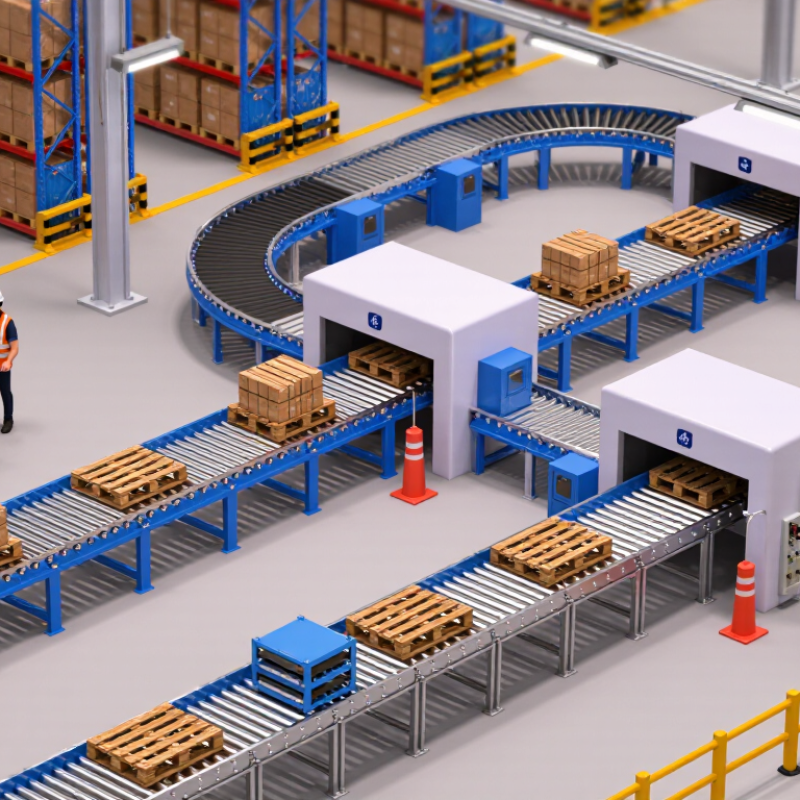
Pallet conveyor systems move loaded pallets through receiving, storage, production, and shipping areas. They reduce manual handling and create steadier material flow. A well-designed line can also improve safety around forklifts and loading zones. Common types include roller conveyors, chain conveyors, and powered turntables. Roller models suit stable pallets with smooth undersides. Chain conveyors handle heavier or uneven loads more reliably. Transfers and lifts connect different conveyor directions or levels.
Core components include frames, rollers or chains, drive motors, sensors, controls, guards, and emergency stops. Load capacity must match the heaviest pallet, not the average one. Conveyor width, pallet dimensions, speed, and accumulation space also need careful checking. In practice, small gaps can cause large delays. Dust, moisture, and uneven floors may affect performance more than expected. Some layouts look efficient on paper but become difficult to maintain.
Tips: Confirm pallet quality before selecting equipment. Test the heaviest load during site trials. Leave access for cleaning and motor replacement. Ask for documented safety ratings, spare-part support, and maintenance training. Do not ignore operator feedback; they often notice jams first. Recheck the design after installation. Real conditions can expose assumptions that drawings hide.
Top Pallet Conveyor Manufacturers for Global Buyers? - Pallet Conveyor Systems: Purpose, Types, and Core Components
| Conveyor System Type | Primary Purpose | Typical Pallet Characteristics | Typical Load Range | Operating Principle | Core Components | Common Applications | Key Selection Factors |
|---|---|---|---|---|---|---|---|
| Powered Roller Conveyor | Continuous horizontal transport of loaded or empty pallets between production, storage, and shipping areas. | Wooden, plastic, or steel pallets with reasonably flat bottom surfaces; standard pallet sizes can be accommodated through conveyor-width selection. | Typically about 500–2,000 kg per pallet, depending on roller diameter, frame construction, drive arrangement, and support spacing. | Motor-driven rollers transfer pallets through direct drive, chain drive, or a line-shaft arrangement. | Drive motor Rollers Chains or belts Frame Sensors Controls | Assembly lines, warehouses, pallet accumulation zones, order fulfillment, and dispatch areas. | Load capacity, pallet underside design, roller pitch, conveyor width, speed, accumulation requirements, and safety guarding. |
| Chain-Driven Roller Conveyor | Move heavy, rigid, or difficult-to-transport pallets with positive traction and reliable starting performance. | Best suited to pallets that provide adequate contact with multiple rollers and have a stable, non-flexing base. | Commonly designed for approximately 1,000–3,000 kg per pallet in heavy-duty installations. | A motor drives a chain loop that rotates each powered roller in the conveying section. | Geared motor Sprockets Drive chain Steel rollers Take-up device Guards | Automotive components, metal products, bulk materials, manufacturing plants, and heavy pallet handling. | Required torque, chain protection, noise level, maintenance access, pallet weight distribution, and duty cycle. |
| Non-Powered Roller Conveyor | Provide economical short-distance movement, manual positioning, or gravity-assisted pallet transfer. | Rigid pallets with a flat and clean underside; pallet movement depends on pushing force or a controlled slope. | Often suitable for approximately 300–1,500 kg per pallet, subject to roller and frame specifications. | Pallets move through manual force or gravity; brake rollers and speed controllers may be used on inclined sections. | Free rollers Support frame Legs Side guides Brake rollers End stops | Workstations, pallet staging, loading docks, inspection areas, and low-volume material handling. | Floor slope, operator ergonomics, pallet condition, stopping control, roller spacing, and required throughput. |
| Chain Transfer Conveyor | Transfer pallets at a right angle between parallel conveyor lines when a conventional curve is unsuitable. | Compatible with pallets whose bottom boards or runners allow safe lifting and support by transfer chains. | Typically about 500–2,000 kg per pallet, depending on the number of chains and lifting mechanism. | Chains raise or support the pallet and move it laterally across the gap between conveyor sections. | Transfer chains Chain sprockets Lift mechanism Drive unit Position sensors Safety interlocks | Cross-docking layouts, production line branching, storage lanes, and pallet sorting systems. | Transfer direction, pallet stability, cycle time, positioning accuracy, available floor space, and lifting height. |
| Pallet Turntable | Change pallet orientation or route pallets between conveyor lines without manually repositioning the load. | Standard and non-standard pallets can be handled if the platform dimensions and load center are correctly specified. | Usually engineered for approximately 500–2,000 kg per pallet. | A rotating platform turns the pallet, commonly through 90 or 180 degrees, before releasing it to the next conveyor. | Rotary platform Drive motor Roller deck Indexing sensors Position locks Control panel | Space-constrained warehouses, packaging lines, pallet labeling, wrapping operations, and conveyor intersections. | Rotation angle, platform size, load center of gravity, indexing accuracy, cycle time, and guarding. |
| Pallet Lift | Raise or lower pallets between different conveyor elevations, floors, or process levels. | Requires a stable pallet and a load that remains secure during vertical movement. | Commonly configured for approximately 500–2,000 kg per pallet, with heavier designs available. | A powered lifting platform positions a roller or chain conveyor deck at the required elevation. | Lift platform Hydraulic or electric actuator Guides Level sensors Safety locks Guarding | Multi-level warehouses, mezzanines, automated storage systems, and transfer points between floors. | Vertical travel, rated load, cycle frequency, platform size, emergency protection, and building clear height. |
| Accumulation Conveyor | Buffer pallets between process stages while allowing upstream and downstream equipment to operate at different rates. | Suitable for uniform pallets with known dimensions and stable loads; accumulation zones should prevent load contact where required. | Often designed for approximately 500–2,000 kg per pallet. | Multiple controlled zones start, stop, or release pallets individually or in groups according to sensor signals. | Zone drives Photoelectric sensors Logic controller Rollers Stop gates Communication network | Packaging, palletizing, warehousing, sorting, production buffering, and shipping preparation. | Zero-pressure or contact accumulation, buffer length, control logic, release pattern, pallet spacing, and throughput. |
| Flexible or Expandable Conveyor | Provide temporary or adjustable pallet movement in changing layouts, loading areas, or seasonal operations. | Usually used with compatible pallet sizes and controlled loads; floor conditions strongly affect performance. | Capacity varies widely; pallet applications generally require a reinforced heavy-duty design. | Conveyor sections extend, retract, or curve to reach different loading and unloading positions. | Telescoping frame Wheels or casters Powered rollers Flexible joints Control pendant End stops | Truck loading, temporary warehouses, container unloading, cross-docking, and short-term logistics projects. | Extended length, floor loading, mobility, docking height, power supply, load stability, and operating environment. |
| Automated Guided Pallet Conveyor Cell | Connect production, storage, and shipping operations with automated pallet routing and minimal manual handling. | Requires defined pallet dimensions, readable identification, consistent load stability, and controlled pallet quality. | System capacity depends on the conveyor modules, vehicle interface, and automation design; many industrial systems handle 500–2,000 kg per pallet. | Conveyors, sensors, programmable controls, and automated vehicles or storage equipment coordinate pallet movement. | Powered conveyors PLC Barcode or RFID readers Safety scanners WMS interface AGV or AMR interface | Smart factories, distribution centers, automated storage and retrieval, and high-volume pallet logistics. | Software integration, routing logic, uptime targets, safety standards, pallet identification, maintainability, and expansion capacity. |
Note: Load ranges and operating characteristics are typical engineering reference values. Final specifications should be confirmed using the actual pallet dimensions, load distribution, duty cycle, speed, environment, and applicable safety requirements.