What Are Plexiglass Sheets Cut to Size?
Plexiglass sheets cut to size are acrylic panels prepared to match a specific length, width, and thickness. They offer a practical alternative to standard, pre-sized sheets when ordinary dimensions leave awkward gaps or unnecessary waste. In a workshop, this might mean a clear panel fitting neatly into a cabinet door, display case, or greenhouse frame.
The cutting process usually begins with accurate measurements and a clear understanding of the installation area. A supplier may use scoring, sawing, routing, or CNC equipment, depending on the material thickness and edge requirements. Thin acrylic can behave differently from thicker stock. It may chip, melt, or develop rough edges when handled with unsuitable tools. Small details matter.
They matter more than expected.
Choosing the correct thickness can improve stiffness, appearance, and durability. Clear acrylic provides visibility, while tinted, frosted, mirrored, or colored options support privacy and design goals. However, plexiglass is not unbreakable, and it can scratch more easily than glass without proper care. That limitation deserves attention before ordering.
A reliable supplier should confirm dimensions, tolerances, corner shapes, polishing options, protective-film coverage, and shipping protection. Customers should review every measurement, including holes, notches, and edge allowances. Even experienced installers occasionally measure from the wrong reference point. This guide examines what plexiglass sheets cut to size are, how customization works, and which practical factors influence the final result. It also considers common mistakes, because a well-cut panel cannot correct an inaccurate measurement.
What “Cut to Size” Means: PMMA Sheets Made to Exact Dimensions
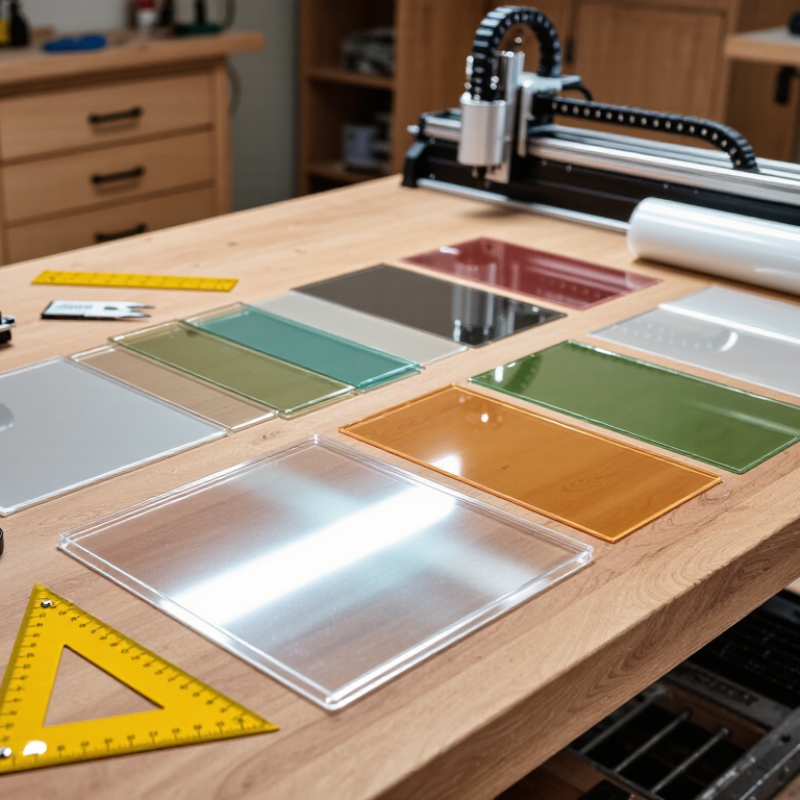
Plexiglass sheets cut to size are PMMA panels manufactured to specific length, width, and thickness requirements. “Cut to size” means the sheet is not supplied only in a standard stock format. It is measured, programmed, and trimmed for a defined application, such as a 600 × 400 millimeter display cover.
That distinction matters. Measure twice.
Fabricators may use panel saws, CNC routers, or lasers, depending on thickness, edge quality, and quantity. A saw can provide efficient straight cuts, while routing supports shaped openings. Laser cutting may create a polished edge, but heat can affect sensitive dimensions.
Practical tolerances should be confirmed before production. A drawing alone may not define them clearly.
The 2024 Grand View Research acrylic sheets market analysis reported continued market growth, supported by demand in construction, lighting, retail displays, and transportation. However, market forecasts vary by region and product definition. This is why technical specifications matter more than a headline percentage. PMMA commonly offers high optical clarity, low weight, and weather resistance, yet it can scratch more easily than glass. Protective film should remain on during handling and installation. In real workshops, small errors often come from measuring the finished opening instead of the required fitting clearance. That mistake is easy to overlook. A reliable order should state dimensions, thickness, edge finish, quantity, tolerance, and intended use.
Material Profile: PMMA Density of 1.17–1.20 g/cm³ and Up to 92% Light
What Are Plexiglass Sheets Cut to Size?
Plexiglass sheets cut to size are PMMA panels manufactured for specific dimensions, openings, or fabrication drawings. PMMA typically has a density of 1.17–1.20 g/cm³, according to technical data referenced in ISO 7823-1. This makes it much lighter than ordinary glass of similar thickness. A 3 mm clear sheet feels manageable during installation, yet it still needs careful support over wide spans.
Clear PMMA can transmit up to 92% of visible light under controlled testing conditions. ASTM D1003 measures this property through luminous transmittance and haze testing. The actual result depends on thickness, surface finish, color, and cutting quality. A polished edge may look almost glass-like. A rough saw-cut edge will scatter light instead. This distinction is often missed.
ASTM D792 is commonly used to determine plastic density, but density alone does not predict field performance. Heat, impact, fastener pressure, and cleaning methods also matter. Cut-to-size panels should allow for thermal movement, especially near warm windows or lighting fixtures. I have seen accurately cut sheets fail because the mounting holes were too tight. Precision is useful, but practical clearance still matters. According to the PlasticsEurope Plastics—The Facts 2023 report, plastics remain important across construction and manufacturing, although application-specific testing remains necessary. That caution is worth keeping.
What Are Plexiglass Sheets Cut to Size? - Material Profile: PMMA Density of 1.17–1.20 g/cm³ and Up to 92% Light
| Material or Cutting Dimension |
Typical Value |
Practical Significance |
| Material |
Polymethyl methacrylate (PMMA) |
A rigid, lightweight thermoplastic commonly known as acrylic or plexiglass. |
| Custom Sheet Size |
Specified by length × width |
Sheets can be ordered or cut to a required footprint to reduce trimming and material waste. |
| Thickness Range |
Commonly 1.5–25 mm |
Thinner sheets suit glazing and displays, while thicker sheets provide greater stiffness and impact resistance. |
| Density |
1.17–1.20 g/cm³ |
PMMA is lighter than glass of comparable volume, which can simplify handling and installation. |
| Visible Light Transmittance |
Up to approximately 92% for clear sheet |
Clear PMMA offers high transparency for windows, covers, signs, partitions, and display panels. |
| Refractive Index |
Approximately 1.49 |
Its optical clarity and light-bending behavior make it suitable for transparent and optical components. |
| Tensile Strength |
Approximately 65–75 MPa |
Indicates the material’s resistance to pulling forces; the actual value varies with grade and test method. |
| Flexural Strength |
Approximately 90–110 MPa |
Useful for assessing performance in panels, guards, covers, and other applications subject to bending. |
| Water Absorption |
Approximately 0.3–0.4% by weight |
Low moisture uptake helps maintain dimensional stability in normal indoor and outdoor environments. |
| Surface Hardness |
Typically around Rockwell M 80–100 |
Provides a relatively hard surface, although PMMA can still scratch without protective handling. |
| Continuous Use Temperature |
Approximately 70–85°C |
Suitable for many ambient-temperature applications; prolonged high heat can cause softening or distortion. |
| Impact Performance |
Higher than ordinary glass, but lower than polycarbonate |
Offers a useful balance of clarity and toughness, but it is not the best choice for severe impact hazards. |
| Machining and Edge Finishing |
Sawing, routing, drilling, laser cutting, and polishing |
Cut-to-size PMMA can be fabricated into precise panels, with polished edges available for improved appearance. |
| Typical Applications |
Glazing, signage, displays, partitions, light covers, and protective panels |
The combination of low weight, transparency, weatherability, and machinability supports a wide range of uses. |
Note: Values are typical for standard clear PMMA sheet. Exact performance depends on formulation, thickness, surface finish, manufacturing process, and the applicable test standard.
Thickness Selection: 3–6 mm Plexiglass for Common Glazing Applications
Plexiglass sheets cut to size are acrylic panels prepared to match a requested width and length. They offer clear light transmission for windows, cabinet doors, partitions, and interior screens. The thickness matters more than many buyers expect. A thin panel may look neat but flex under pressure.
For common glazing, 3 mm suits small frames with good edge support. It works well for picture covers, lightweight cabinet inserts, and sheltered openings.
Choose 4 mm when the panel needs more stiffness or faces regular handling. This option feels steadier in medium-sized frames.
Panels around 5 mm provide a useful balance for larger indoor glazing. They reduce visible bowing when the opening has limited support.
At 6 mm, acrylic becomes noticeably stronger and more substantial. It is often preferable for broad panels, partitions, or areas exposed to vibration.
In practical fitting work, I measure the opening twice and check the frame depth. A small clearance prevents pressure buildup during temperature changes. My early measurements were sometimes too exact. That mistake taught me to allow for installation movement. Clear acrylic can still scratch, so clean handling and soft tools matter. I also inspect the supporting frame before choosing thickness. A 6 mm sheet cannot correct a weak or uneven frame. For outdoor glazing, wind, size, and support spacing need separate engineering review.
Cutting Methods: Sawing, CNC Routing, and Laser Processing Explained
What Are Plexiglass Sheets Cut to Size?
Cutting Methods: Sawing, CNC Routing, and Laser Processing Explained
Plexiglass sheets cut to size are acrylic panels trimmed to specified dimensions before delivery or installation. The best cutting method depends on sheet thickness, edge appearance, shape, and quantity. For straight cuts, a fine-tooth circular saw or panel saw can produce reliable results. The sheet should be supported fully, and its protective film should remain in place to reduce scratches. Feed the blade steadily; forcing it can cause chipping or heat buildup. Small chips matter when an edge will remain visible.
CNC routing suits curves, slots, and repeated shapes. A computer-controlled router follows a programmed path, making it useful for panels with precise openings. The cut edge may need light sanding or polishing. Laser processing can create detailed designs and smooth, glossy edges, especially on suitable acrylic grades. However, heat can leave stress marks or discoloration, and some thicknesses cut less cleanly. Test pieces help. They add time, but can prevent a costly full-sheet mistake. Whatever the method, confirm dimensions, corner details, and tolerances before cutting. Even careful shops sometimes need a second check.
Quality Specifications: ASTM D638 Testing and Professional Size Tolerances
Plexiglass sheets cut to size are PMMA panels trimmed to specified length, width, and shape. Quality depends on more than a clean edge. ASTM D638-22 evaluates tensile strength, elongation, and failure behavior using controlled plastic specimens. Typical PMMA technical data, aligned with ISO 7823-1 guidance, reports tensile strength near 60–75 MPa and elongation around 2–5%. Results change with thickness, temperature, molding method, and test speed.
Professional cutting tolerances require clear drawings. A practical tolerance may be ±0.5 mm for smaller machined panels, while larger sheets can require ±1.0 mm or more. ASTM D638 does not define cutting dimensions. It verifies material performance instead. That distinction matters. A sheet may pass tensile testing but still arrive slightly outside the requested size. Heat from sawing can also soften an edge, create stress, or produce a small dimensional shift. Experience shows that “perfect” tolerances are not always realistic, especially with thin panels or complex cutouts.
Tips: Ask for the finished size, thickness, corner radius, and measurement method. Keep protective film on during inspection. Measure at room temperature with calibrated tools. Request an ASTM D638 test report when strength matters. Check the report’s specimen type, conditioning, test speed, and failure values. A vague certificate is weak evidence. Even experienced buyers can overlook this detail.
Plexiglass Sheets Cut to Size: ASTM D638 & Size Tolerances
ASTM D638 is a test method for measuring tensile properties of plastics; it does not set a universal acceptance value for every acrylic sheet. The chart shows illustrative ±1/16 in cut-size tolerance bands—not a guaranteed industry standard. Confirm the tolerance with your supplier.