Posts

Top 10 Types of Plastic Parts Global Buyers Need?

Global buyers rarely purchase plastic parts as simple shapes. They purchase repeatable performance, stable supply, and fewer production surprises. A small connector may need tight tolerances, flame resistance, and reliable electrical insulation. A food container may require clarity, impact strength, and clean molding surfaces. Each requirement changes the material, tooling, process, and inspection plan.

Professor Tim A. Osswald, a respected plastics processing researcher and author, emphasizes that “design and processing cannot be separated.” That principle guides this overview of the top ten plastic parts demanded by international buyers. The list covers practical categories, including injection-molded housings, automotive clips, medical components, packaging closures, gears, seals, transparent covers, electrical connectors, structural brackets, and custom prototypes. These parts appear in factories, vehicles, appliances, laboratories, and everyday packaging.

Performance comes first.

Yet the buying decision is rarely perfect. Some buyers focus heavily on unit price and underestimate mold maintenance, resin availability, or dimensional change after cooling. Others request premium materials without defining the actual operating conditions. That creates waste, delays, and awkward redesigns. A better evaluation considers load, temperature, moisture, chemical exposure, surface finish, expected volume, and end-use standards. Supplier experience also matters. A capable manufacturer can explain gate locations, draft angles, shrinkage risks, inspection methods, and realistic tolerances before production begins. This guide examines what global buyers commonly need, why each plastic part matters, and where specifications deserve a second look.
Top 10 Types of Plastic Parts Global Buyers Need?

What Defines a Plastic Part in Global Industrial Supply

A plastic part is more than a molded shape. In global industrial supply, it is a functional component with a defined material, process, tolerance, and application. Common types include housings, covers, brackets, gears, clips, fluid fittings, panels, rollers, protective caps, and custom enclosures. Each type creates different production demands.

A reliable definition begins with the engineering drawing. It should identify resin grade, color, dimensions, surface finish, and critical tolerances. Process choice also matters. Injection molding suits repeatable volumes, while CNC machining supports precise prototypes and low quantities. Thermoforming creates large panels, and blow molding produces hollow containers. I have seen attractive samples fail because their wall thickness was uneven. That small issue caused warping during assembly. Appearance can mislead.

Tips: Ask for a material datasheet, inspection report, and sample approval record. Check shrinkage, impact strength, temperature resistance, and chemical exposure. Confirm whether recycled content is acceptable for the application. Keep these requirements written, not discussed only in messages. A simple control plan prevents expensive confusion across time zones. Still, specifications are not perfect. Suppliers and buyers should review unclear tolerances together before production. Endless precision can increase cost without improving performance. The best plastic part balances function, manufacturability, consistency, and total delivered value.

Top 10 Types of Plastic Parts Global Buyers Need

Common industrial plastic part categories and the representative density of their commonly specified resin.

Density is shown in grams per cubic centimeter (g/cm³) using typical values for unfilled resin grades. Actual values vary by grade, additives, reinforcement, and manufacturing specification.

The Ten Main Types of Plastic Parts Buyers Commonly Source

Top 10 Types of Plastic Parts Global Buyers Need?

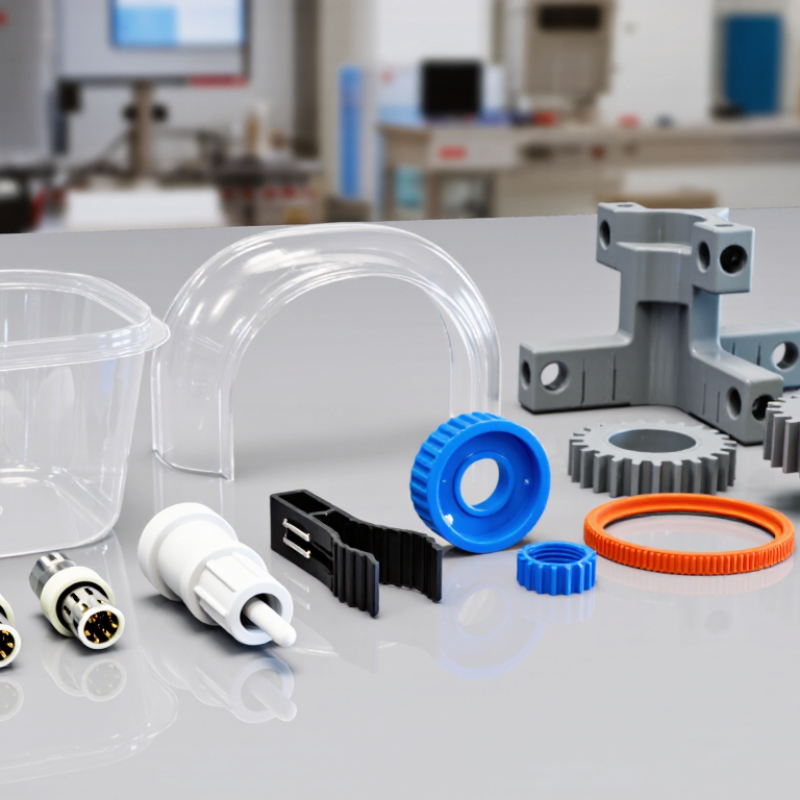
The ten main types of plastic parts buyers commonly source serve different production needs. Injection-molded housings protect electronics, meters, and compact control units. Caps and closures support packaging lines, where thread accuracy and sealing pressure matter. Gears and rollers require stable dimensions, low friction, and suitable wear resistance.

Clips and fasteners simplify assembly when buyers need quick installation without metal hardware. Seals and gaskets help prevent dust, moisture, or fluid leakage in demanding environments.

Pipes and tubes are widely purchased for air, water, and chemical transfer systems.

Transparent covers and lenses need clean surfaces, controlled clarity, and minimal optical distortion.

Connectors and terminal blocks must maintain reliable electrical separation and secure cable positioning.

Overmolded grips combine a rigid plastic core with a softer outer layer, improving handling comfort.

Thin-wall trays and inserts protect components during storage, shipping, and automated assembly.

From sourcing experience, material selection often affects results more than appearance. A strong design can still fail because of shrinkage, warping, or an unsuitable mold gate. I have seen buyers approve samples too quickly. That decision created costly assembly problems later.

Request dimensional reports, material data, surface samples, and functional testing before mass production. Tolerances should match the actual application, not an unrealistic drawing standard. Some parts also need flame resistance, food-contact suitability, or outdoor durability. These requirements must be verified through appropriate documentation and testing.

How Plastic Parts Differ by Material, Design, and Function

Plastic parts vary widely because material, design, and function must work together. Global buyers commonly source ten types: housings, gears, clips, seals, connectors, caps, panels, handles, ducts, and trays. Each type faces different demands. ABS suits rigid housings and clean surfaces. Polypropylene handles chemicals and repeated movement well. Polyamide supports gears, but moisture can change its dimensions. Polycarbonate protects transparent covers against impact. Thermoplastic polyurethane adds flexibility to seals and grips. Material names alone are not enough.

Design controls performance too. Thin walls reduce weight, yet they may warp during cooling. Ribs strengthen a panel without adding much material. Snap-fits speed assembly, but repeated opening can weaken them. Threads require accurate shrinkage control. Smooth corners reduce stress and improve mold filling. In production work, I check wall thickness, draft angles, tolerances, and expected load before approving a part. Small details matter. A seal may need flexibility at low temperatures. A connector may need stable alignment after hundreds of cycles. Food-contact or medical applications require documented material grades and traceable inspection records. Some choices still involve compromise. A stronger resin may cost more, mold slower, or produce a less attractive surface. Test results should guide revisions, not assumptions.

Top 10 Types of Plastic Parts Global Buyers Need: How Plastic Parts Differ by Material, Design, and Function

Rank Plastic Part Type Common Materials Typical Design Features Primary Function and Applications Common Manufacturing Processes Important Buyer Requirements
1 Injection-Molded Housings and Enclosures ABS PC/ABS Polypropylene Nylon Thin-wall shells, snap-fits, bosses, ribs, screw towers, ventilation slots, and textured surfaces. Protects electronic, electrical, medical, consumer, and industrial components from impact, dust, and handling damage. Injection molding; secondary drilling, printing, painting, ultrasonic welding, or assembly. Consistent wall thickness, controlled shrinkage, good surface finish, dimensional stability, and reliable parting-line design.
2 Automotive Interior and Exterior Trim PP TPO ABS PC/ABS PA Large visible surfaces, clips, mounting points, grain textures, curved profiles, and integrated air or cable channels. Interior panels, consoles, grilles, bezels, mirror components, door trim, and under-hood covers. Injection molding, compression molding, blow molding, thermoforming, and overmolding. UV resistance, temperature performance, low odor, scratch resistance, color consistency, impact strength, and tight fit.
3 Caps, Closures, and Dispensing Components HDPE PP LDPE PET Threads, tamper-evident rings, flip-top hinges, dispensing orifices, sealing liners, and child-resistant features. Seals and dispenses beverages, food, cosmetics, household chemicals, pharmaceuticals, and personal-care products. Injection molding, compression molding, injection blow molding, and extrusion blow molding. Leak prevention, thread accuracy, hinge durability, food or pharmaceutical compliance where required, and reliable opening torque.
4 Gears, Rollers, Bushings, and Mechanical Components Acetal (POM) Nylon PEEK UHMW-PE Precision teeth, bearing surfaces, keyed bores, wear pads, low-friction profiles, and reinforced hubs. Transfers motion, reduces friction, supports loads, guides assemblies, and replaces metal parts in selected mechanisms. Precision injection molding, CNC machining, compression molding, and insert molding. Dimensional accuracy, wear resistance, coefficient of friction, moisture absorption, fatigue life, and load capacity.
5 Electrical Connectors and Insulating Parts PA 66 PBT PC LCP PPS Fine pin cavities, polarization keys, locking tabs, cable seals, strain reliefs, and compact multi-cavity geometry. Insulates and positions terminals in automotive, industrial, consumer, energy, and electronic assemblies. High-precision injection molding, insert molding, and automated assembly. Electrical insulation, flame retardancy, heat resistance, low moisture sensitivity, terminal retention, and flash control.
6 Medical and Laboratory Plastic Components PP PE PC COC/COP TPU Fluid paths, luer connections, transparent chambers, ergonomic grips, sterile barriers, and single-use geometries. Syringe parts, diagnostic housings, sample containers, fluid-management components, and laboratory consumables. Cleanroom injection molding, extrusion, blow molding, thermoforming, and ultrasonic welding. Biocompatibility, traceability, particulate control, sterilization compatibility, leak tightness, transparency, and repeatability.
7 Flexible Seals, Gaskets, and Overmolded Parts Silicone TPU TPE EPDM NBR Sealing lips, O-ring profiles, compression beads, soft-touch zones, and elastomer layers bonded to rigid substrates. Prevents leakage, absorbs vibration, protects against dust, improves grip, and provides environmental sealing. Compression molding, transfer molding, injection molding, liquid silicone molding, and two-shot overmolding. Hardness, compression set, chemical resistance, temperature range, tear strength, bond quality, and sealing force.
8 Bottles, Tanks, and Hollow Containers HDPE PET PP PVC Uniform walls, handles, neck finishes, ribs, integrated closures, barrier layers, and stackable shapes. Stores beverages, detergents, lubricants, chemicals, cosmetics, and other liquid or granular products. Extrusion blow molding, injection blow molding, stretch blow molding, and rotational molding. Leak resistance, chemical compatibility, drop performance, wall uniformity, barrier properties, recyclability, and volume accuracy.
9 Protective Packaging Inserts and Trays EPS EPP PET PVC PP Product cavities, shock-absorbing ribs, stacking features, retaining tabs, drainage holes, and folded or hinged sections. Protects electronics, tools, medical products, food, industrial parts, and retail goods during storage and transportation. Thermoforming, foam molding, injection molding, die cutting, and vacuum forming. Cushioning performance, accurate fit, low weight, stackability, clean appearance, material recovery, and efficient nesting.
10 Custom Profiles, Tubes, and Extruded Parts PVC TPU PE PP PC Constant cross-sections, hollow channels, co-extruded layers, sealing fins, grooves, and cut-to-length sections. Used for cable conduits, tubing, window seals, edge protection, fluid lines, guides, and structural channels. Profile extrusion, tube extrusion, co-extrusion, calibration, cutting, drilling, and secondary forming. Cross-section accuracy, surface quality, flexibility, pressure rating, UV stability, chemical resistance, and cut-length consistency.

Note: The ranking represents common global sourcing categories based on broad industrial use across packaging, automotive, electronics, medical, consumer, and industrial markets. Actual material selection and specifications should be validated against the product’s operating conditions, regulations, and lifecycle requirements.

Key Factors for Comparing and Selecting Plastic Parts

Global buyers commonly source ten plastic part types: housings, covers, brackets, clips, gears, knobs, trays, caps, ducts, and protective guards. Comparing them requires more than checking unit price. Review material strength, operating temperature, chemical exposure, wall thickness, and expected service life. A thin cover may look efficient, yet it can warp near a hot motor.

Manufacturing method also affects selection. Injection molding suits repeat production and consistent dimensions. CNC machining supports prototypes or low-volume parts. For each option, compare tooling cost, cycle time, surface finish, tolerance, and minimum order quantity. I have seen buyers approve attractive samples without checking assembly pressure. That mistake created cracked clips during installation. Small details matter.

Tips: Request a material data sheet, dimensional inspection report, and sample parts from the same production process. Test clips repeatedly, measure warpage after heating, and check screw bosses for splitting. Ask how rejected parts are controlled. Do not rely on color alone; recycled content or pigment changes can affect performance. A clear drawing should identify critical dimensions, mating surfaces, and inspection points. Keep communication practical. Send photos of the real assembly, not only a computer model.

A reliable supplier should explain limitations rather than promise perfection. Lead time may change with mold revisions, resin availability, or inspection delays. Buyers should record these risks before approving production. A perfect specification rarely exists. Sometimes, a slightly thicker part is the safer choice.

Manufacturing Standards and Quality Checks for Global Buyers

Top 10 Types of Plastic Parts Global Buyers Need: Manufacturing Standards and Quality Checks for Global Buyers

Global buyers often source housings, covers, gears, clips, brackets, connectors, valves, seals, rollers, and custom inserts. Each part needs a clear drawing, resin specification, tolerance range, and inspection plan. Material certificates should identify grade, batch, color, and basic performance data. Without these details, even a visually perfect part creates risk.

Experienced quality teams check dimensions with calibrated calipers, gauges, or coordinate measuring machines. They inspect flash, sink marks, warpage, weld lines, short shots, and surface scratches. Critical dimensions deserve 100% inspection. Less important features may follow an agreed sampling plan. Standards such as ISO 9001, ISO 2768, ASTM methods, or customer-specific requirements can support consistent decisions. The standard must match the part’s actual use.

A first-article inspection should compare samples against approved drawings and sealed references. Functional tests may include assembly trials, leak checks, load testing, temperature exposure, or repeated movement. Packaging also matters. Thin clips can break inside crowded cartons. Moisture-sensitive materials need suitable storage and handling. A clean inspection report can still hide weak testing.

One practical lesson is uncomfortable: buyers sometimes approve appearance before performance. That mistake is expensive. Suppliers should record mold changes, machine settings, inspection results, and corrective actions. Photos help, but measured data matters more. Even experienced teams can miss a small tolerance shift after tool maintenance. Independent inspections are useful when production volume, distance, or risk is high.